![Net for truncated cuboctahedron, an Archimedean solid, Quatuor his suaru[m] Institutionum geometricarum libris (Four Books on Measurement), by Albrecht Dürer, p. 156, 1534 (Linda Hall Library)](https://assets-us-01.kc-usercontent.com:443/9dd25524-761a-000d-d79f-86a5086d4774/05d51aeb-2dd1-4949-880d-ec62209058fd/durer1.jpg?w=420&h=458&auto=format&q=75&fit=crop)
Scientist of the Day - Albrecht Dürer

![Net for truncated cuboctahedron, an Archimedean solid, Quatuor his suaru[m] Institutionum geometricarum libris (Four Books on Measurement), by Albrecht Dürer, p. 156, 1534 (Linda Hall Library)](https://assets-us-01.kc-usercontent.com:443/9dd25524-761a-000d-d79f-86a5086d4774/2f844213-fc99-44c5-b4cb-4c9131d0d2ad/durer1.jpg?w=420&h=600&auto=format&q=75&fit=crop)
Net for truncated cuboctahedron, an Archimedean solid, Quatuor his suaru[m] Institutionum geometricarum libris (Four Books on Measurement), by Albrecht Dürer, p. 156, 1534 (Linda Hall Library)
Albrecht Dürer, a German painter, engraver, and theorist on perspective, proportion, and geometry, was born in Nuremberg on May 21, 1471. He was important for Renaissance natural history with his stress on "naturalism" – drawing from nature rather than from other illustrations – and his influence can be traced directly on the first printed book to have images "drawn from life," the herbal of Otto Brunfels. Dürer also had an impact on celestial cartography with his two printed star maps of 1515, about which we recently wrote a post. Dürer’s woodcut of a rhinoceros (1515) determined how people saw and drew this exotic beast from the East for two centuries, until Clara the rhino showed up in Germany and France in the 1740s. We have written a post about Dürer's rhino (and about Clara).
.jpg#/media/File:Albrecht_D%C3%BCrer,_Selbstbildnis_mit_26_Jahren_(Prado,_Madrid).jpg)
Self-portrait of Albrecht Dürer, oil on panel, 1498, Museo del Prado, Madrid, (Wikimedia commons)
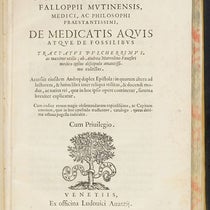
But Dürer also wrote several theoretical treatises, one on proportion, another on measurement, which is mostly about geometry. These were originally published in German, because Dürer was a strong advocate for German culture, but the treatises were translated into Latin soon after his death, and we have both treatises in Latin in 1534 editions, bound into one volume.

![Title page, Quatuor his suaru[m] Institutionum geometricarum libris (Four Books on Measurement), by Albrecht Dürer, 1534 (Linda Hall Library)](https://assets-us-01.kc-usercontent.com:443/9dd25524-761a-000d-d79f-86a5086d4774/a6e95115-32f0-44ba-9152-df613a498698/durer3.jpg?w=399&h=600&auto=format&q=75&fit=crop)
Title page, Quatuor his suaru[m] Institutionum geometricarum libris (Four Books on Measurement), by Albrecht Dürer, 1534 (Linda Hall Library)

![Generating Gothic type fonts with geometric shapes, Quatuor his suaru[m] Institutionum geometricarum libris (Four Books on Measurement), by Albrecht Dürer, p. 142, 1534 (Linda Hall Library)](https://assets-us-01.kc-usercontent.com:443/9dd25524-761a-000d-d79f-86a5086d4774/6f381e52-21d2-42e1-86bd-b5f5feab6dec/durer4.jpg?w=421&h=600&auto=format&q=75&fit=crop)
Generating Gothic type fonts with geometric shapes, Quatuor his suaru[m] Institutionum geometricarum libris (Four Books on Measurement), by Albrecht Dürer, p. 142, 1534 (Linda Hall Library)

![Gothic type fonts, filled in, Quatuor his suaru[m] Institutionum geometricarum libris (Four Books on Measurement), by Albrecht Dürer, p. 143, 1534 (Linda Hall Library)](https://assets-us-01.kc-usercontent.com:443/9dd25524-761a-000d-d79f-86a5086d4774/6ede8c27-6559-4a8a-8a04-9c8434084b82/durer5.jpg?w=401&h=600&auto=format&q=75&fit=crop)
Gothic type fonts, filled in, Quatuor his suaru[m] Institutionum geometricarum libris (Four Books on Measurement), by Albrecht Dürer, p. 143, 1534 (Linda Hall Library)
It is hard to get very far into the Four Books on Measurement without being sidetracked by Dürer’s venture into type design, where he generated German black type from squares and triangles (fourth and fifth images), but we leap ahead to book 4, where Dürer discussed first the 5 Perfect or Platonic Solids, which most people have heard of, and then, surprisingly, the 13 Archimedean solids, or semi-perfect polyhedra, which most people are not familiar with. Archimedes had shown that while there are only 5 ways to make regular polyhedra out of one regular polygon (equilateral triangles, squares, or pentagons), there are 13 solids to be had when you use multiples of two regular polygons (squares and equilateral triangles, hexagons and squares, etc.). No one in the 16th century knew about Archimedean solids, but Dürer discovered 7 of these on his own. The names we now use for the 13 Archimedean solids were invented by Johannes Kepler in the 17th century, and they are cumbersome (except for the delightful snub cube), and anachronistic, but scholars use them anyway. Dürer probably discovered all 13 – the 6 he omitted all have pentagons as sides, and the pentagon is difficult to construct with just a compass and straightedge; any reader would have a hard time making them. Dürer showed the pentagon only once in his book – when he discussed the last Platonic solid, the dodecahedron (sixth image).

![Net for dodecahedon, a Platonic solid, Quatuor his suaru[m] Institutionum geometricarum libris (Four Books on Measurement), by Albrecht Dürer, p. 149, 1534 (Linda Hall Library)](https://assets-us-01.kc-usercontent.com:443/9dd25524-761a-000d-d79f-86a5086d4774/c1b36468-b818-477b-a580-54ed966702a8/durer6.jpg?w=398&h=600&auto=format&q=75&fit=crop)
Net for dodecahedon, a Platonic solid, Quatuor his suaru[m] Institutionum geometricarum libris (Four Books on Measurement), by Albrecht Dürer, p. 149, 1534 (Linda Hall Library)
Anyway, the most interesting feature of Dürer’s discussion of the semi-regular solids is the way he visually presented them. He imagined them as being constructed from a single sheet of paper, folded along the edges to make the polyhedron, and then unfolded and flattened for us to view. This kind of presentation of a solid is called a "net," and Dürer invented it. He showed us nets for each of his Archimedean solids, and we show 3 of them here: the truncated cuboctahedron (first image), the snub cube (seventh image), and the cuboctahedron and the truncated octahedron together on one page (eighth image). You can see all 7 at our scan of the book, beginning on page 159 of the PDF and paging forward.
![Net for snub cube, an Archimedean solid, Quatuor his suaru[m] Institutionum geometricarum libris (Four Books on Measurement), by Albrecht Dürer, p. 156, 1534 (Linda Hall Library)](https://assets-us-01.kc-usercontent.com:443/9dd25524-761a-000d-d79f-86a5086d4774/cec46fa7-8988-4842-8fe1-92f8614321f5/durer7.jpg?w=399&h=600&auto=format&q=75&fit=crop)
Net for snub cube, an Archimedean solid, Quatuor his suaru[m] Institutionum geometricarum libris (Four Books on Measurement), by Albrecht Dürer, p. 156, 1534 (Linda Hall Library)

![Nets for cuboctahedron (top) and truncated octahedron (bottom), two Archimedean solids, Quatuor his suaru[m] Institutionum geometricarum libris (Four Books on Measurement), by Albrecht Dürer, p. 153, 1534 (Linda Hall Library)](https://assets-us-01.kc-usercontent.com:443/9dd25524-761a-000d-d79f-86a5086d4774/20be9405-5a12-4b6b-84ca-0a8be4bcd0b8/durer8.jpg?w=400&h=600&auto=format&q=75&fit=crop)
Nets for cuboctahedron (top) and truncated octahedron (bottom), two Archimedean solids, Quatuor his suaru[m] Institutionum geometricarum libris (Four Books on Measurement), by Albrecht Dürer, p. 153, 1534 (Linda Hall Library)
The only Renaissance mathematicians to discuss Archimedean solids before Dürer (also without knowing about Archimedes' discovery) were Piero della Francesca and Luca Pacioli, and both discussions were included in Pacioli's book, Divina proportione (1509), which we discussed in a recent post on Pacioli (and showed two of Leonardo da Vinci's perspective drawings of semi-regular polyhedra). The “net” as a way of presentation had not yet been invented.

![The art of painting with perspective, woodcut by Albrecht Dürer, in his Quatuor his suaru[m] Institutionum geometricarum libris (Four Books on Measurement), p. 183, 1534 (Linda Hall Library)](https://assets-us-01.kc-usercontent.com:443/9dd25524-761a-000d-d79f-86a5086d4774/5e5b7a13-4ad0-4454-a704-1cb803468720/durer9.jpg?w=621&h=600&auto=format&q=75&fit=crop)
The art of painting with perspective, woodcut by Albrecht Dürer, in his Quatuor his suaru[m] Institutionum geometricarum libris (Four Books on Measurement), p. 183, 1534 (Linda Hall Library)
It is not clear if Dürer knew about the work of Piero and Pacioli, although Dürer was in Milan at the same time as Pacioli and Leonardo were. For those of you who could not care less about Archimedean solids, I offer you, as our final image, one of the two woodcuts by Dürer that end our edition of Four Books on Measurement, showing Dürer using a sighting device to paint a scene in perfect perspective (last image).
William B. Ashworth, Jr., Consultant for the History of Science, Linda Hall Library and Associate Professor emeritus, Department of History, University of Missouri-Kansas City. Comments or corrections are welcome; please direct to ashworthw@umkc.edu.