Scientist of the Day - Ivan Pavlov

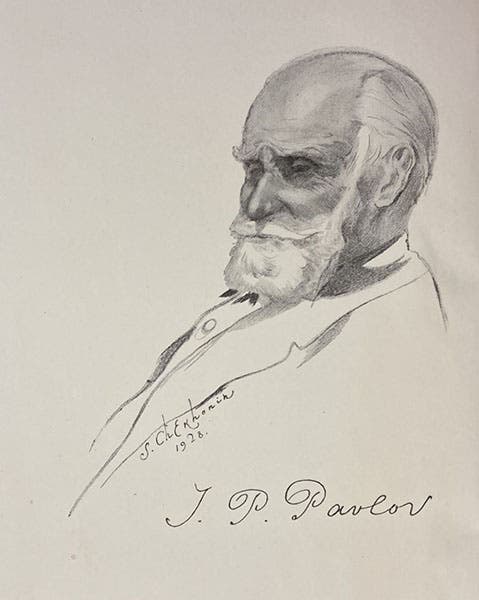
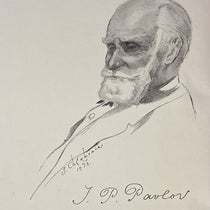
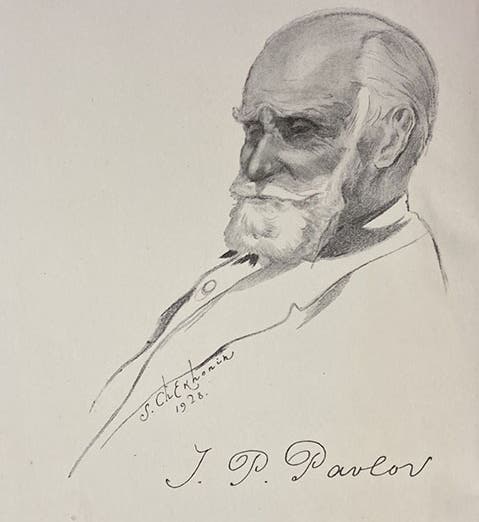
Portrait of Ivan Petrovich Pavlov, charcoal drawing by Sergey Chekhonin, 1928, frontispiece to Lectures on Conditioned Reflexes, by Ivan Petrovich Pavlov, transl. by W. Horsley Gantt, vol. 1, 1928-1941 (Linda Hall Library)
Ivan Petrovich Pavlov, a Russian experimental physiologist, died Feb. 27, 1936, at the age of 86. Pavlov was born on Sep. 26, 1849, in Ryazan, south of Moscow, not far from where the great Russian rocket pioneer, Konstantin Tsiolkovskii, would soon grow up. Pavlov was intended for the Russian Orthodox priesthood, like his father, but he gave that up – gave up religion altogether, in fact – to study science at St. Petersburg University. Pavlov had a early predilection for experimental science, and for physiology, and his career followed naturally from that.

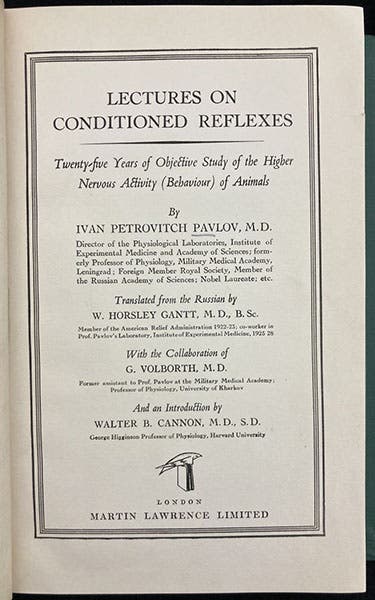
Title page to volume 1, Lectures on Conditioned Reflexes, by Ivan Petrovich Pavlov, transl. by W. Horsley Gantt, vol. 1, 1928 (Linda Hall Library)
Pavlov had an uncertain 20 years, before 1891, as he experimented on digestion and the circulatory system and the workings of the pancreas and looked for a good research position. He happened to be in the right place, St. Petersburg, when and where the Institute of Experimental Medicine was founded in 1888, and in 1891, he was appointed director, a position he held for the rest of his career. He was also, after 1895, professor of physiology at the Medical Military Academy in St. Petersburg.

Russian postage stamp commemorating Ivan Petrovich Pavlov and his experiments on digestion in dogs, 2024 (Wikimedia commons)
Pavlov first achieved world-wide attention with his experiments on digestion in dogs, for which he received the Nobel Prize in Physiology/Medicine in 1904. The Prize had just been founded in 1901, and Pavlov was only the third recipient of the award. But he was already on the way to the discovery that would make him even more famous, the conditioned (or conditional) reflex. Pavlov discovered that the digestive juices of a dog could be triggered by a stimulus that had nothing to do with food. If the dog were exposed to a stimulus, such as the sound of a buzzer, before feeding, it would become conditioned to associate that stimulus with food, and would salivate accordingly whenever it heard the buzzer.

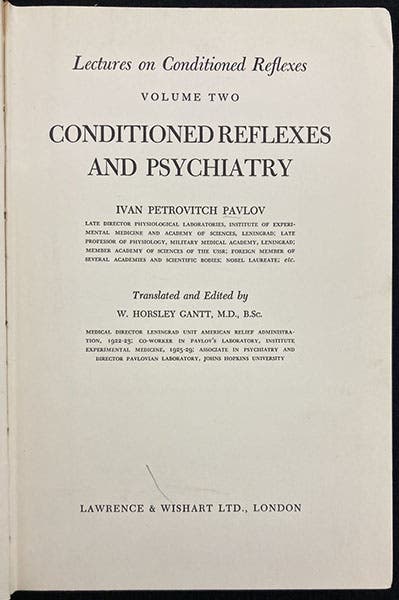
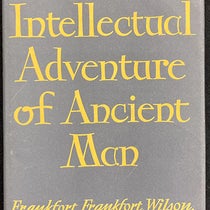
Title page to volume 2, Lectures on Conditioned Reflexes, by Ivan Petrovich Pavlov, transl. by W. Horsley Gantt, vol. 2, 1941 (Linda Hall Library)
As he expanded his interest from physiology to psychology, Pavlov was fortunate to find favor with Lenin and Soviet communism, even though he seems to have had little use for or faith in communism. He was after all, just about the only Nobelist in Russia, and authorities wanted him to stay there and be happy. It was also in the 1920s that his work was discovered by the West, and a collection of Pavlov's papers on conditioned reflexes was published in translation in England and the United States, a first volume in 1928 (which contains an original portrait by the famous Russian portrait artist, Sergey Chekhonin, first image), and a second volume in 1941. We have both of these in our Library (second and fourth images).

The Pavlov Memorial Museum, Ryazan, former home of the Ivan Pavlov (Wikimedia commons)
Pavlov died of pneumonia in 1936, just before things got really nasty in Russia under Stalin, so Pavlov's reputation avoided tarnish, and it remains high today. His childhood home in Ryazan is now a Pavlov Museum (fifth image). A Russian postage stamp was issued in Pavlov’s honor as recently as 2024, presumably a centennial stamp, although I do not know exactly what it commemorates (third image)

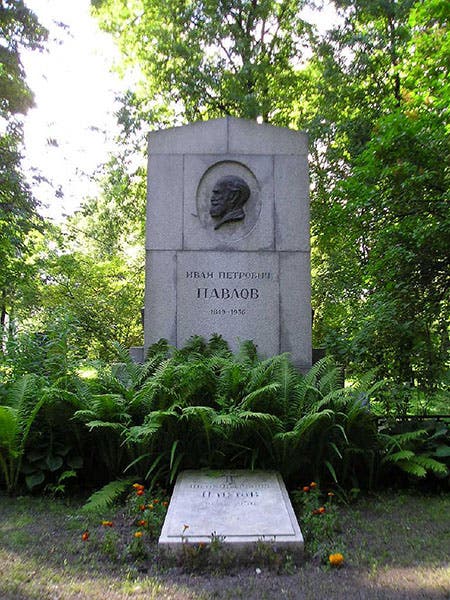
Tombstone of Ivan Petrovich Pavlov, Literatorskie Mostki (Writers’ Bridges), Volkovskoye Cemetery, St. Petersburg, recent photograph (findagave.com)
Pavlov was buried in the arts-and-sciences section of the Volkovskoye Cemetery in St. Petersburg, which is called the Literatorskie Mostki, or Literary Bridges, since in the muddy old days, you had to walk on wooden planks to get from grave to grave. I don't know how many planks it took to get from Pavlov's grave to the grave of Dmitrii Mendeleev, but he is there too.
William B. Ashworth, Jr., Consultant for the History of Science, Linda Hall Library and Associate Professor emeritus, Department of History, University of Missouri-Kansas City. Comments or corrections are welcome; please direct to ashworthw@umkc.edu.