Scientist of the Day - Paul-Antoine Cap

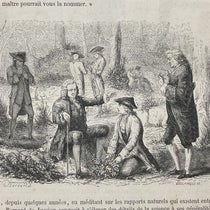
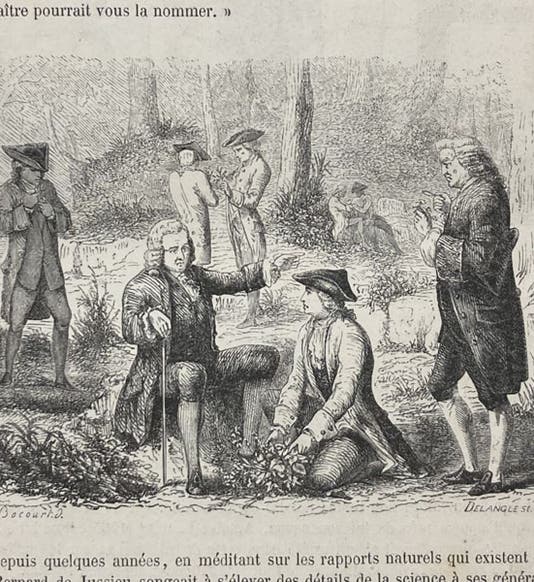
Linnaeus teaching in the field, wood engaving, Le muséum d'histoire naturelle, by Paul-Antoine Cap, part 1, detail of p. 15, 1854 (Linda Hall Library)
Paul-Antoine Gratacap, always called Cap, a French naturalist and pharmacist, was born Apr. 2, 1788, in Macon. He wrote several books on pharmacy and the history of pharmacy which we do not have in our collections. But we do have one of his publications, called Le museum d'histoire naturelle (1854), which seems generally unknown to scholars of 19th-century natural history, and is therefore an untapped resource, which is too bad, since it is crammed with images that are seldom seen in the secondary literature.
,_naturaliste,_S1073.jpg#/media/File:Portrait_s%C3%A9rieux_de_Paul-Antoine_Gratacap,_dit_Cap_(1768-1877),_naturaliste,_S1073.jpg)
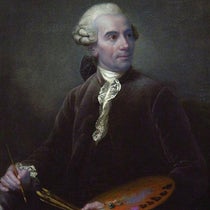
Bust of Paul-Antoine Cap, sculpted by Jean Pierre Dantan, 1841, Musée Carnavalet, Paris, 1841 (Wikimedia commons)
There are, first of all, portraits galore. As one who needs to find a portrait a day for my subject of the day, I am acutely aware of the paucity of published portraits of naturalists, and yet here we find portrayals not only of well-known figures such as Carl Linnaeus and the Comte de Buffon (fourth image), but also of minor naturalists. They are drawn from a variety of sources; some are engraved copies of paintings, while others are copies of busts or funeral reliefs. All seem genuine, which means that the ones I know from other sources are recognizable, suggesting that the unfamiliar likenesses are reliable ones.

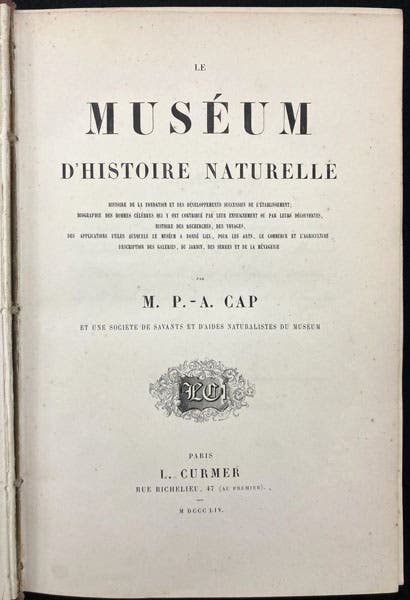
Title page, Le muséum d'histoire naturelle, by Paul-Antoine Cap, 1854 (Linda Hall Library)

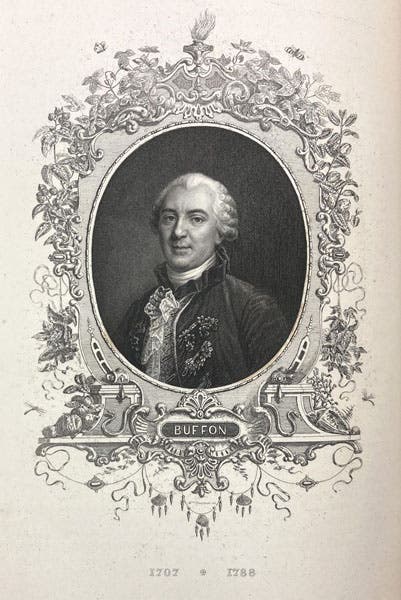
Portrait of George Louis Leclerc, comte de Buffon, engraving, Le muséum d'histoire naturelle, by Paul-Antoine Cap, part 1, p. 14 entire, 1854 (Linda Hall Library)
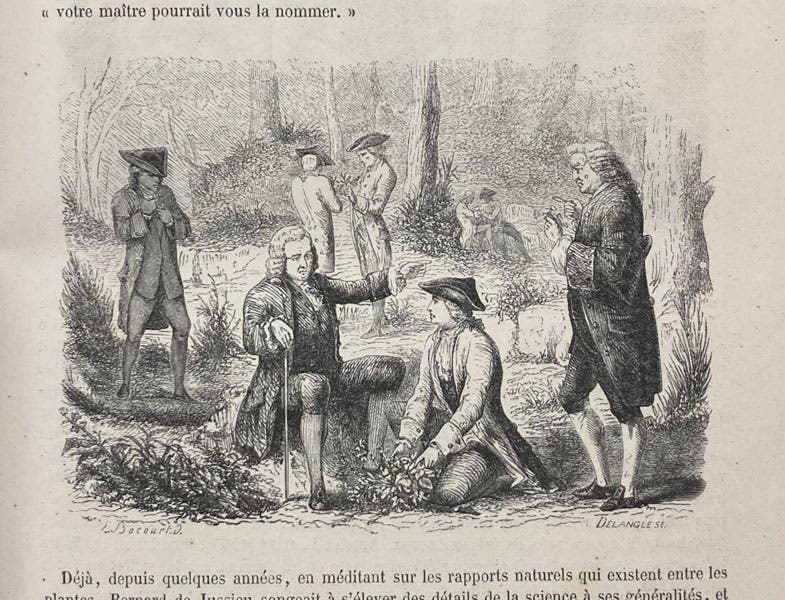
The second kind of illustration in Cap's book are reconstructions of important moments in natural history, such as the scene depicting Linnaeus teaching his students on a field trip (first image), or of Antoine Jussieu watering plants on board a ship (fifth image). These are all found in the first part of the book, which is devoted to the history of natural history. They are all wood engravings, printed in the text, as you can see in our fifth image, and are similar to the kind of illustration made popular by Louis Figuier in his Les merveilles des science (1867), except that Cap is doing this 13 years before Figuier.

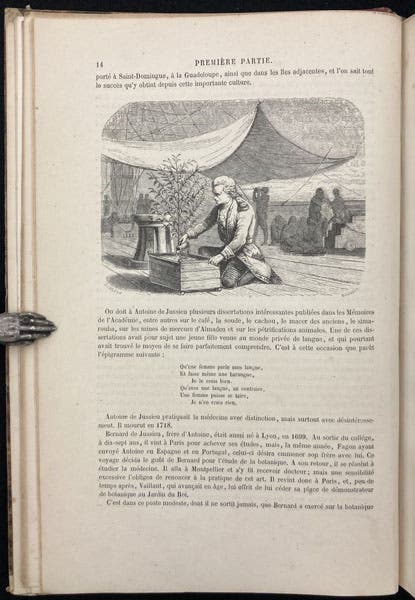
Antoine Jussieu watering plants onboard ship, wood engaving, Le muséum d'histoire naturelle, by Paul-Antoine Cap, part 1, p. 14 entire, 1854 (Linda Hall Library)
The third kind of image, completely unexpected in a book like this, are floral plates, showing flowers from the Jardin des Plantes. These, like the fuchsia (sixth image), are full-page prints that appear to be woodcuts printed in color, although they may have color added by hand. There are not many of these, and they seem quite out of place in a book like this, but they are undeniably beautiful, and probably attracted buyers.
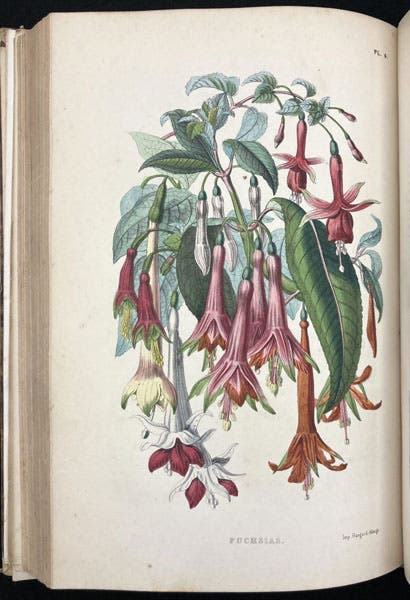
Fuchsia, colored woodcut?, Le muséum d'histoire naturelle, by Paul-Antoine Cap, part 2, plate 4, p. 75, 1854 (Linda Hall Library)
The second part of the book, paginated separately, is a guide to the Paris Museum Menagerie and Botanical Gardens. There are dozens of text wood engravings that show animal enclosures and garden settings. I show just one, a full-page engraving of the greenhouses at the Jardin (seventh image). And I could not resist including one of the two plates of birds, this one a colored woodcut of hummingbirds (last image).

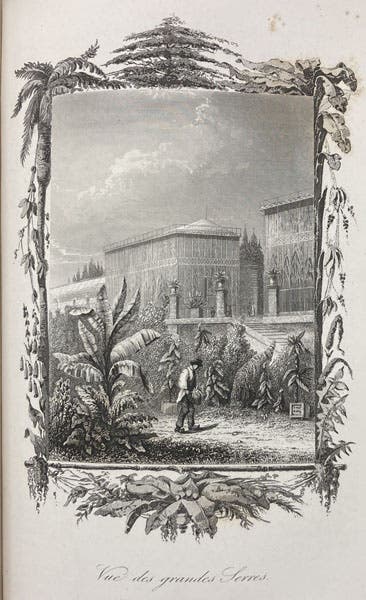
View of the greenhouses at the Jardin des Plantes, full-page engraving, Le muséum d'histoire naturelle, by Paul-Antoine Cap, part 2, opp. p. 12, 1854 (Linda Hall Library)
I found this book by accident, not that long ago, sitting there on the quarto shelves of our vault, and I was quite surprised when I pulled it from its slot and saw what was inside. I have never seen it referred to, nor any of its portraits or historical scenes (or floral plates) reproduced. I hope to change that, the next time I write about a French naturalist.

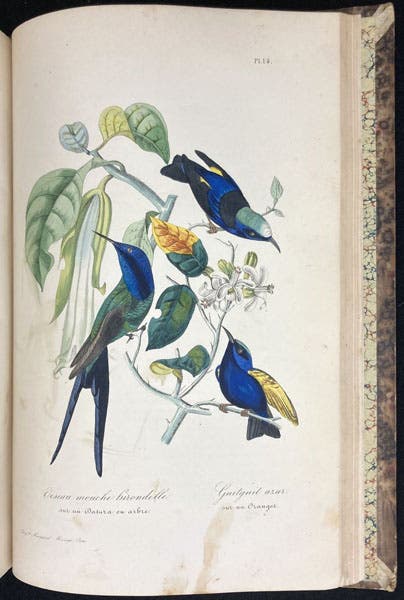
Hummingbirds, colored woodcut?, Le muséum d'histoire naturelle, by Paul-Antoine Cap, part 2, plate 14, p. 168, 1854 (Linda Hall Library)
There is no portrait of Cap himself in the book, that I could find. Fortunately, there is a wonderful bust in the Musée Carnavalet in Paris (second image).
William B. Ashworth, Jr., Consultant for the History of Science, Linda Hall Library and Associate Professor emeritus, Department of History, University of Missouri-Kansas City. Comments or corrections are welcome; please direct to ashworthw@umkc.edu.