Scientist of the Day - Phillip Parker King

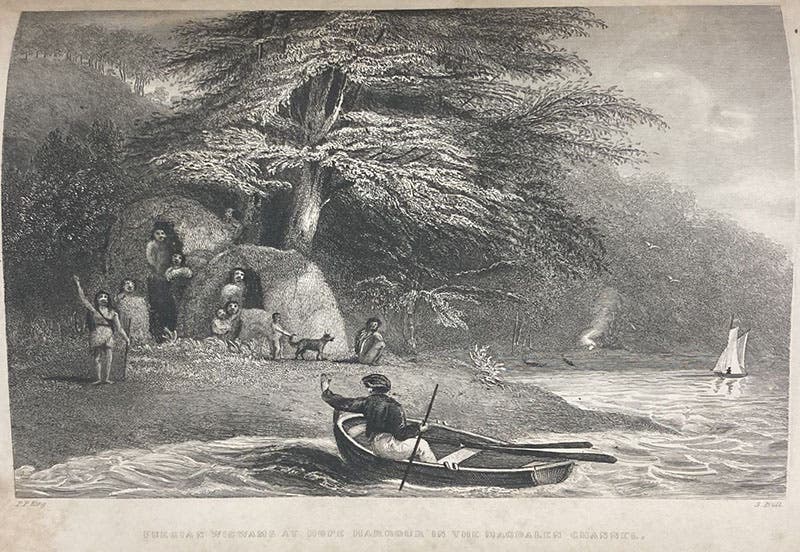
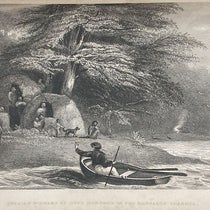
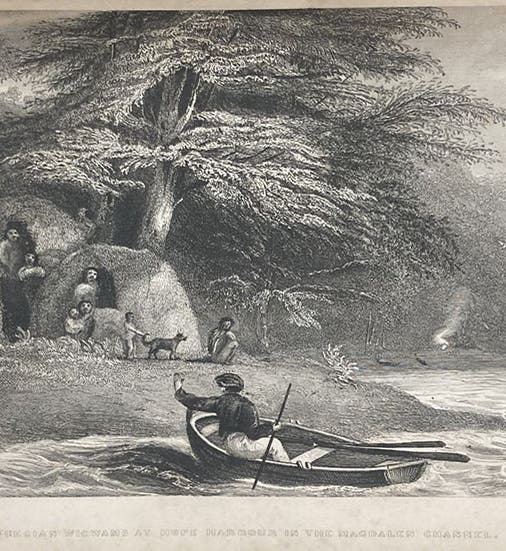
Fuegian wigwams at Hope Harbour, Straits of Magellan, etching after a drawing by Phillip Parker King, in Narrative of the Surveying Voyages of His Majesty's Ships Adventure and Beagle, between the Years 1826 and 1836, by Robert FitzRoy, vol. 1, page 26, 1839 (Linda Hall Library)
Phillip Parker King, an officer in the British Royal Navy, died Feb. 26, 1856, at the age of 64. He had been born on Dec. 13, 1791, on Norfolk Island (how many people do you know who were born on Norfolk Island?). His father, Philip Gidley King (yes, Philip with one “l,” go figure), was also a naval officer and an early Governor of New South Wales.

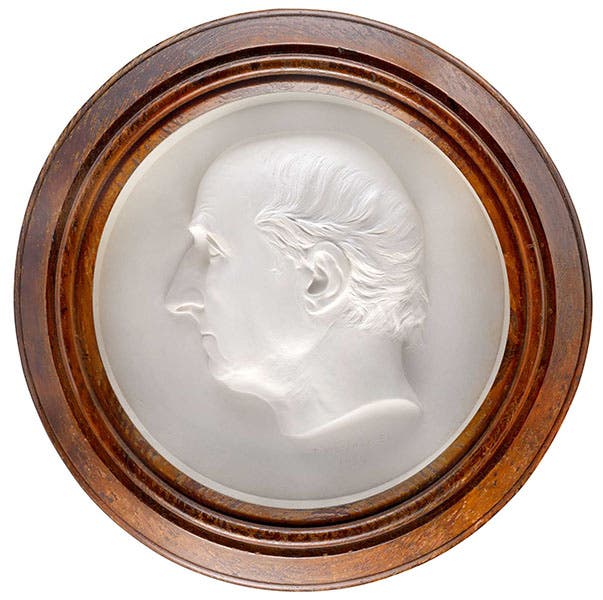
Portrait of Phillip Parker King, plaster relief by Thomas Woolner, National Portrait Gallery of Australia (portrait.gov.au)
The younger King is known as the commander of the other voyage of HMS Beagle, the first voyage that explored South America from 1826-1830, before Charles Darwin came aboard as a supernumerary. This was a two-ship expedition, with King aboard HMS Adventure and in command of both ships. The captain of the Beagle was Pringle Stokes, who became depressed after spending two years in the rough and sunless seas of Tierra del Fuego and committed suicide in August of 1828. Robert FitzRoy was transferred in to replace him, which is how he happened to be in command when the Beagle was sent back to South America in 1831 and Darwin came aboard.

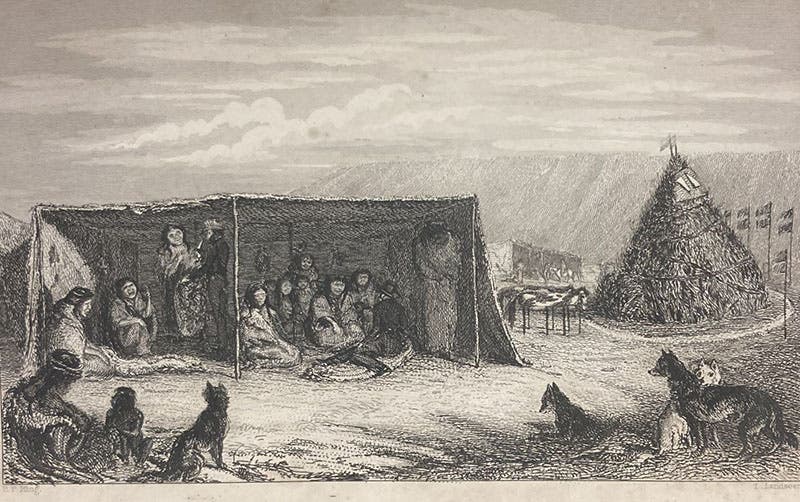
Patagonian “toldo” and the tomb of a young girl at right, etching after a drawing by Phillip Parker King, in Narrative of the Surveying Voyages of His Majesty's Ships Adventure and Beagle, between the Years 1826 and 1836, by Robert FitzRoy, vol. 1, page 94, 1839 (Linda Hall Library)
King prepared an account of the first expedition of the Adventure and the Beagle, but he appears to have left it to FitzRoy to publish, which FitzRoy finally did, incorporating it as volume 1 of his own narrative of the second Beagle voyage in 1839, where FitzRoy’s narrative is volume 2, Darwin’s is volume 3, and an appendix makes up the fourth and last volume. We acquired our four-volume set in 2008, just in time for our Darwin bicentennial exhibition, The Grandeur of Life (2009), which is how we happen to have King’s narrative. You will notice that the title page of volume 1 (fourth image) makes no mention of King at all, although it does mention HMS Adventure.

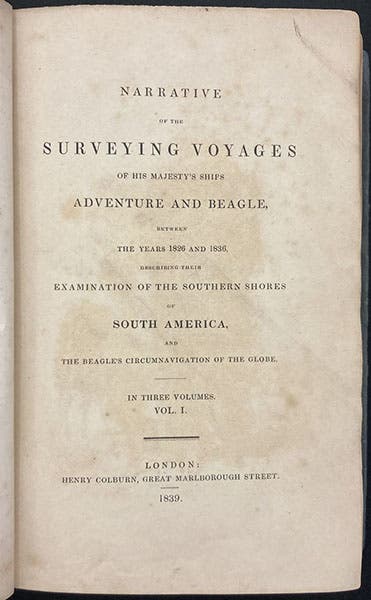
Title page, volume 1, Phillip Parker King’s narrative, in Narrative of the Surveying Voyages of His Majesty's Ships Adventure and Beagle, between the Years 1826 and 1836, by Robert FitzRoy, 1839 (Linda Hall Library)
King was a a very good artist, and he made many sketches of landscapes he encountered and of native Fuegian encampments (first image). He observed a funeral of a young Patagonian girl – that is her tomb, at the right of the "toldo" or lean-to shelter (third image). He also made a striking drawing of a Patagonian male, which was used as a frontispiece for his narrative (fifth image)

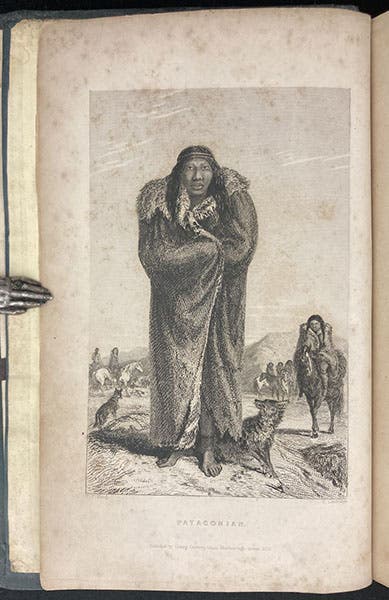
“Patagonian,” etched frontispiece after a drawing by Phillip Parker King, in Narrative of the Surveying Voyages of His Majesty's Ships Adventure and Beagle, between the Years 1826 and 1836, by Robert FitzRoy, vol. 1, 1839 (Linda Hall Library)
However, when he put together King's narrative for publication, FitzRoy also included, without comment, drawings made on the second Beagle voyage by his own artists. So the etching of Mount Corcovado in Rio de Janeiro was drawn by Augustus Earle, and the one of Mount Sarmiento, with a ship in the foreground, was drawn by Conrad Martens. Neither artist was present with King in 1826-30, and their illustrations really do not belong in this volume, but rather in volume 2 or 3.

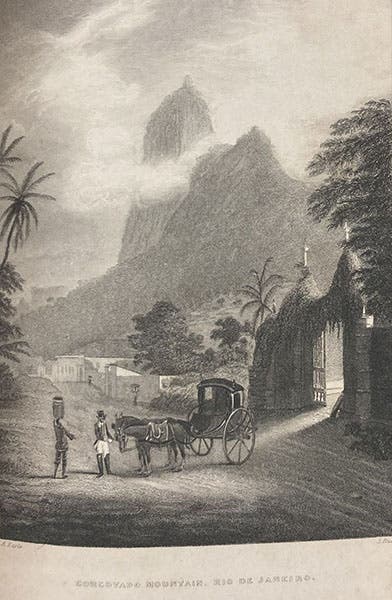
Mount Corcovado in Rio de Janeiro, etching after a drawing by Augustus Earle, in Narrative of the Surveying Voyages of His Majesty's Ships Adventure and Beagle, between the Years 1826 and 1836, by Robert FitzRoy, vol. 1, p. 188, 1839 (Linda Hall Library)
Before he ventured to South America, King, as a very young man, had led four short surveying expeditions along the coast of Australia, from 1818 to 1822, in an attempt to fill in the holes left by the Matthew Flinders expedition of 1801-03, which did not do a very good job of mapping the reefs and shoals that imperiled ships looking for places to land. For the first three of his expeditions, King commanded the small cutter Mermaid, which was badly damaged in 1820 and only repaired enough to get them home. These early voyages led by King were ignored for a century and a half, but eventually it was realized that King was responsible for the first good map of the coast of Australia, and that he had done what Flinders should have done, but did not. I did not realize that we own King’s narrative of those 4 voyages (1827) until I was well into writing this one. We will discuss King’s early surveying work in a subsequent post

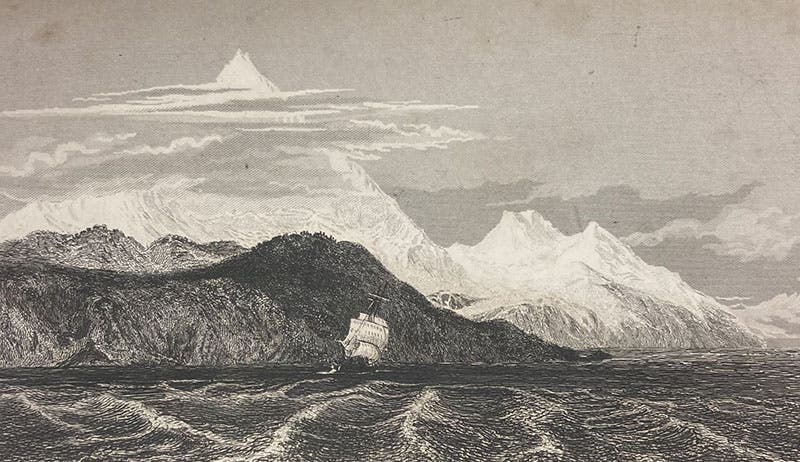
Mount Sarmiento in Tierra del Fuego, with HMS Beagle in the foreground, etching after a drawing by Conrad Martens, in Narrative of the Surveying Voyages of His Majesty's Ships Adventure and Beagle, between the Years 1826 and 1836, by Robert FitzRoy, vol. 1, p. 252, 1839 (Linda Hall Library)
King spent his later life in Australia, retired as an Admiral, and was given a splendid funeral in Sydney Harbor in 1856. The event was recorded in watercolor by Conrad Martens, the artist for FitzRoy and Darwin during the last half of their Beagle voyage, 1832-34. His painting of King's funeral is now in the State Library of New South Wales (last image).

Funeral of Phillip Parker King, Sydney Harbour, 1856, painting by Conrad Martens, State Library of New South Wales (Wikimedia commons)
William B. Ashworth, Jr., Consultant for the History of Science, Linda Hall Library and Associate Professor emeritus, Department of History, University of Missouri-Kansas City. Comments or corrections are welcome; please direct to ashworthw@umkc.edu.