Scientist of the Day - Best Friend of Charleston

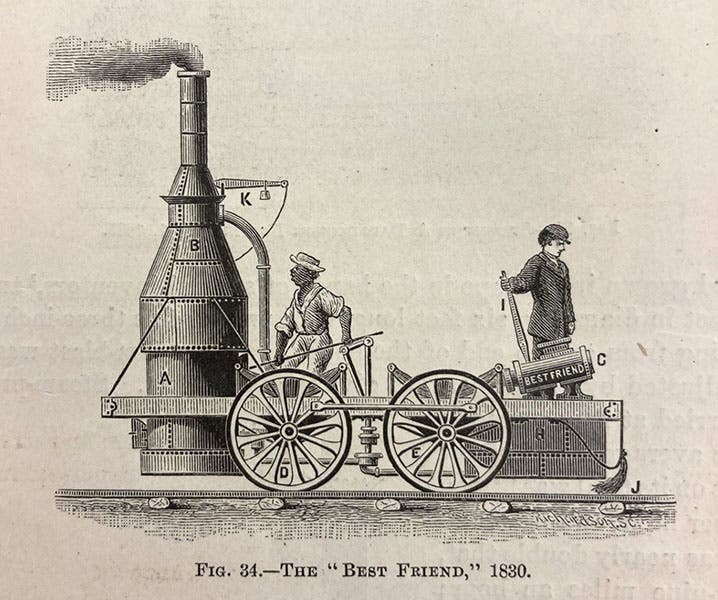
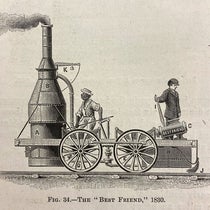
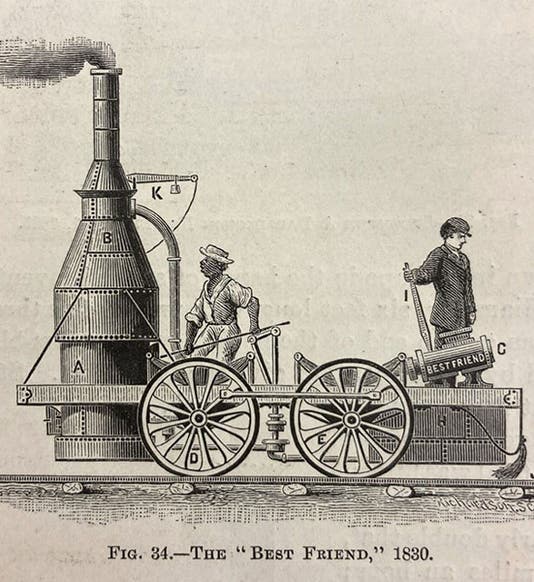
Best Friend of Charleston locomotive, wood engraving, Popular Science Monthly, vol. 12, fig. 34, detail of p. 270, 1878 (Linda Hall Library)
The Best Friend of Charleston, a steam locomotive, was built by the West Point Iron Foundry in New York City in the late summer of 1830, was delivered to the South Carolina Canal and Railroad Company (SCC&RR) in the fall, and made its first run in Charleston on Christmas Day, 1830. As best we can tell, it was the first locomotive built in the United States for passenger service. It had a vertical boiler and inclined pistons, weighed 10,000 pounds, and developed about 12 horsepower. It was capable of puffing along at 20 mph, and it pulled a passenger car and/or a flat car back and forth on six miles of Charleston track for almost six months. Then, on this day, June 17, 1831, it blew itself apart in a boiler explosion. It is said the fireman forcibly weighted down the safety valve because its venting was annoying him. The fireman was killed in the explosion.

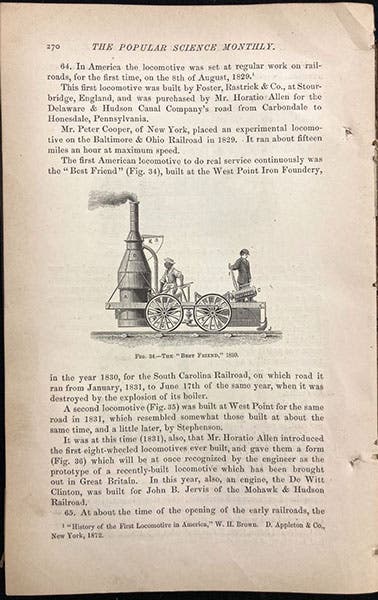
Best Friend of Charleston locomotive, Popular Science Monthly, vol. 12, p. 270, 1878 (Linda Hall Library)
A few of the earliest locomotives, built in the period from 1829 to 1831, survive in some form in science or railroad museums. The Rocket, which won the Rainhill Trials in England in 1829, would be the best-known example, on display in the Science Museum in London. Some, such as the Novelty, have left behind a few parts. Most, such as the Tom Thumb, which preceded the Charleston locomotive in the United States, but was never put into service, have simply disappeared. The Best Friend of Charleston vanished more violently, although it is said that some of its chassis was re-used for a subsequent locomotive.

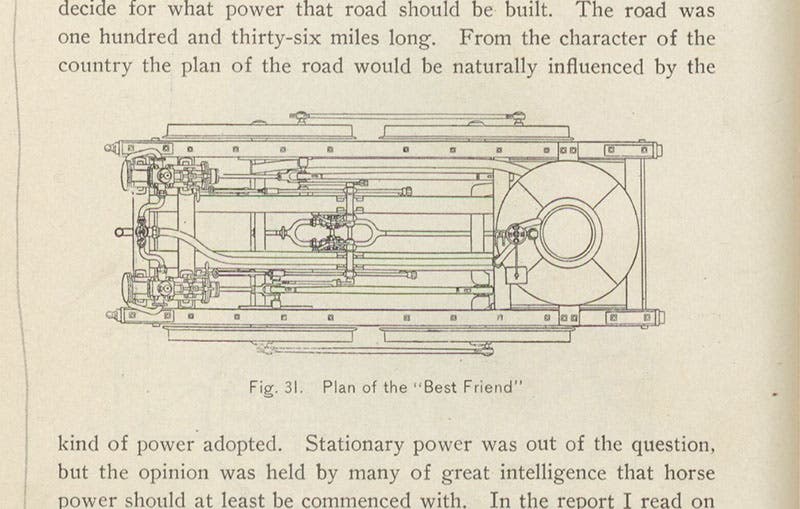
Plan of the Best Friend of Charleston locomotive, wood engraving in Development of the Locomotive Engine, by Angus Sinclair, p. 54, fig. 31, 1907 (Linda Hall Library)
When the centennial of railroading came around in 1929-30, lots of railroads and railway booster societies commissioned replicas of the first locomotives, and nearly always working ones. The replica engineers typically relied on drawings published in trade journals such as Mechanics' Magazine, since usually no actual blueprints survived, although supposedly the plans for the Best Friend were given to the American Society of Mechanical Engineers, and were used to make our third image. The builders of replicas nearly always substituted modern materials, such as steel for wrought iron and copper, for reasons of safety and ease of workmanship, so the "replicas" were not really replicas at all, but look-alikes with totally new working mechanisms.
.jpg#/media/File:Best_Friend_of_Charleston,_Southern_Railway_System_(32714098016).jpg)
Replica of Best Friend of Charleston locomotive, built in 1928, Charleston, South Carolina, recent photo (Wikimedia commons)
Such was the case with the Best Friend of Charleston. A working replica was commissioned in 1928 by the Southern Railway System, the successor to the original SCC&RR. It was quite popular with railroad buffs (as was the replica Tom Thumb, built around the same time), and the Best Friend of Charleston replica is still with us, housed since 2014 in its own museum building in Charleston. I have not seen it, but would like to. I do not know if it still makes excursions outside of its barn.
There are several videos of the Best Friend of Charleston in replica operation on YouTube. I like this one that was recorded on 8mm film way back in 1974! The first minute of the video shows our Best Friend in action.
William B. Ashworth, Jr., Consultant for the History of Science, Linda Hall Library and Associate Professor emeritus, Department of History, University of Missouri-Kansas City. Comments or corrections are welcome; please direct to ashworthw@umkc.edu.