Scientist of the Day - City of Adelaide

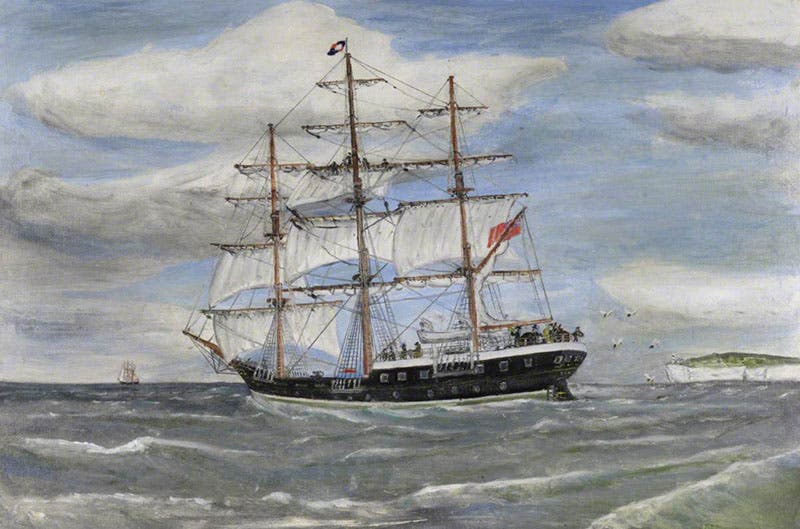
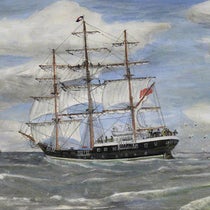
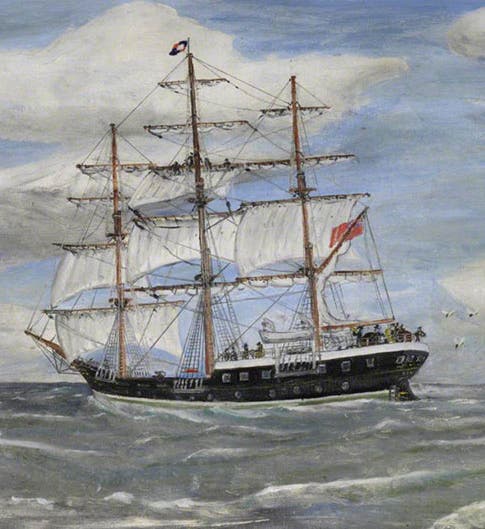
City of Adelaide, 1864, Crossing the Bar, oil on canvas, by A. J. S. Morrison, 1992, Scottish Maritime Museum (artuk.org)
The City of Adelaide, an English clipper ship, was launched on May 7, 1864, from the shipyard of William Pile in Sunderland, Tyne and Wear, about 10 miles southeast of Newcastle in northern England. The clipper ship had been invented in the United States in the 1840s to do something that the new steamships could not manage – carry light-weight goods, like tea, over long distances, such as from China, in a relatively short span of time. Clipper ships were long and lean, with thousands of square feet of sail, and could move along in excess of 20 knots, their holds unburdened by coal.

City of Adelaide, lithograph by Thomas Dutton, 1864 (Wikimedia commons)
Pile was the first ship-builder to launch clipper ships in England. The City of Adelaide was intended to take emigrants to Australia. Unlike Sydney and Brisbane, populated by convicts, Adelaide, on Australia's southern shore, was a free city, and desperately in need of citizens. The City of Adelaide, over the course of 23 years, carried thousands of would-be Australians from England, one trip per year, and on the return voyage, the City of Adelaide filled its small hold with wool and copper for the home market. It was a very successful arrangement for everyone until the clipper ship era ended abruptly in the late 1880s.

Section of a composite ship like the City of Adelaide, with wooden planking over an iron frame (Wikimedia commons)
City of Adelaide was a composite ship, meaning that it had an iron frame, to provide strength, covered with wooden planks (third image). The underwater timbers were then sheathed with copper, to increase speed and reduce fouling by seaweed and barnacles. You could not put copper sheathing directly on an iron hull, for it would turn the ship into a giant battery that would eat itself away by electrolysis.

Shipyard of William Pile, Sunderland, Tyne and Wear, oil on panel, unknown artist, 1830s, Sunderland Museum & Winter Gardens (Wikimedia commons)
City of Adelaide had 23 useful years of commercial life, but its old age was less luminous. It served as a hospital ship during the wars, and as a training ship, but mostly it just sat at harbor in Irvine in Scotland and rotted away, until it finally sank. Someone finally realized that the ship was a national treasure, one of only two surviving clipper ships (the other being the Cutty Sark st Greenwich). Its masts and rigging were gone, but it still seemed worth preserving. It took a long time, and a great deal of money and international goodwill, but the City of Adelaide was finally mounted on a special cradle and shipped to the Australian city of Adelaide to be installed as an outdoor museum and a reminder of how the city was populated (fifth and sixth images). The ship was, in a sense, Australia's Mayfllower, and well worth hanging on to, since what there is left is absolutely original. And it is the oldest surviving clipper ship in the world.

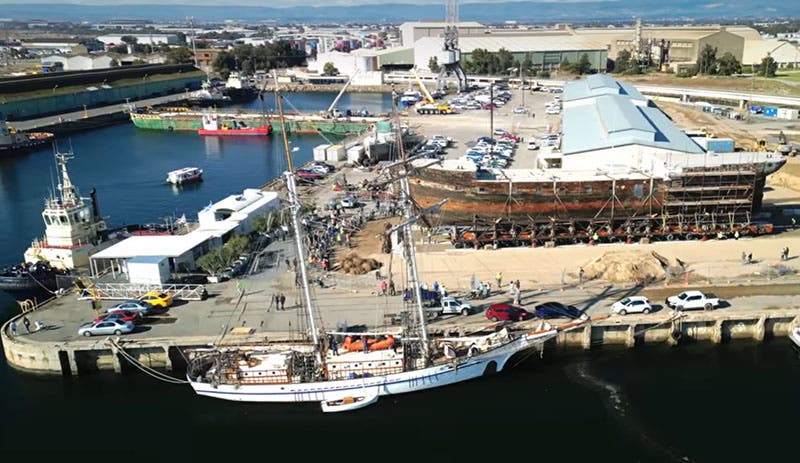
Hull of the City of Adelaide, on public display in Adelaide, Australia (cityofadelaide.org.au)

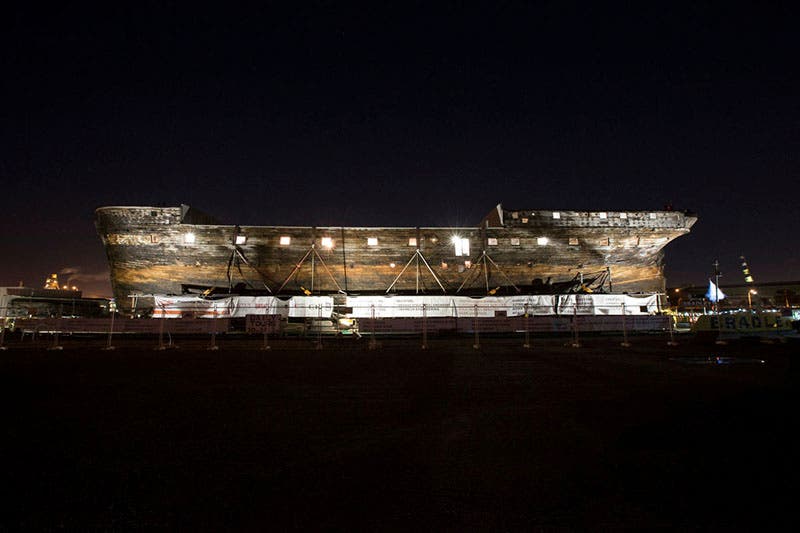
Night view of hull of City of Adelaide, on public display in Adelaide, Australia (cityofadelaide.org.au)
One of the reasons why American clipper ships are so well known, and British ships so rarely recognized, is the presence of Currier and Ives in the U.S. The lithographic team made large colored prints of every notable American vessel, which circulated by the thousands, so if you want to be impressed by a view of the famous Sea Witch, or the Flying Cloud, reproductions are easy to find (you can start with our posts on John Willis Griffiths and Donald McKay, or Nathaniel Currier, for that matter). But the City of Adelaide has only a single lithograph, apparently extant in one example and available only in a low-resolution copy (our second image), and the same is true of the Cutty Sark, of which we have no contemporary views at all. Images are an important part of the historical record, and when they are not there, the record is much less compelling. Otherwise, we are left with our first image, a wonderful painting showing the City of Adelaide at half-sail, but made in 1992, and of no historical value whatsoever.
William B. Ashworth, Jr., Consultant for the History of Science, Linda Hall Library and Associate Professor emeritus, Department of History, University of Missouri-Kansas City. Comments or corrections are welcome; please direct to ashworthw@umkc.edu.