Scientist of the Day - Edward Augustus Inglefield

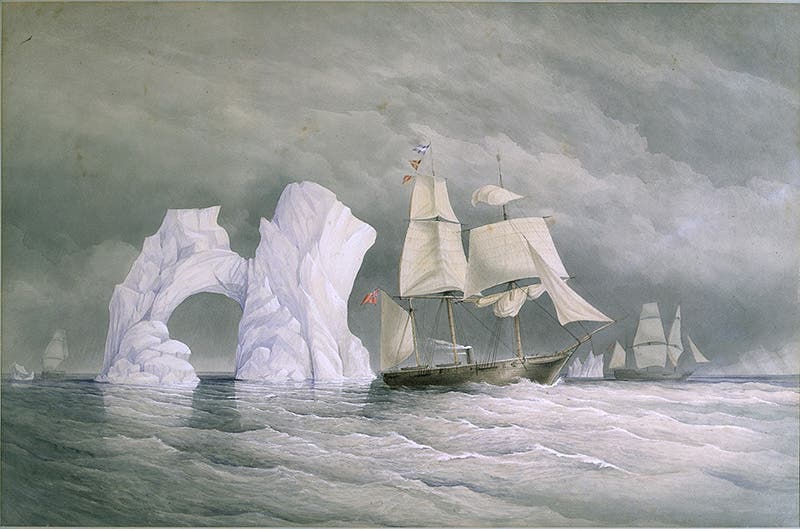
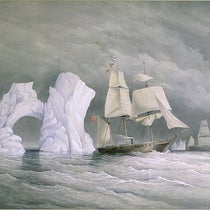
HM Steamship Phoenix, with Talbot and Diligence, passing an iceberg, watercolor by Edward Augustus Inglefield, 1853, National Maritime Museum, Greenwich (rmg.co.uk)
Edward Augustus Inglefield, an officer in the Royal Navy, died Sep. 4, 1894, at the age of 74. In 1818, two years before Inglefield was born, John Barrow sent the first ships into Baffin Bay in search of a northwest Passage through the Arctic archipelago of North America. Edward Parry and his crews made it halfway across on his second attempt in 1819. It seemed that this was not going to be difficult. But 30 years and many expeditions later, the Royal Navy was still looking for a seaway through the ice, and had the John Franklin expedition not disappeared in 1845, the Northwest Passage might not have been found. But when Franklin's ships, HMS Erebus and Terror, failed to return or pass through, dozens of search expeditions were sent out, from 1849 on. Inglefield was instrumental in completing the first Northwest Passage, although the £10,000 reward for the feat went to someone else.

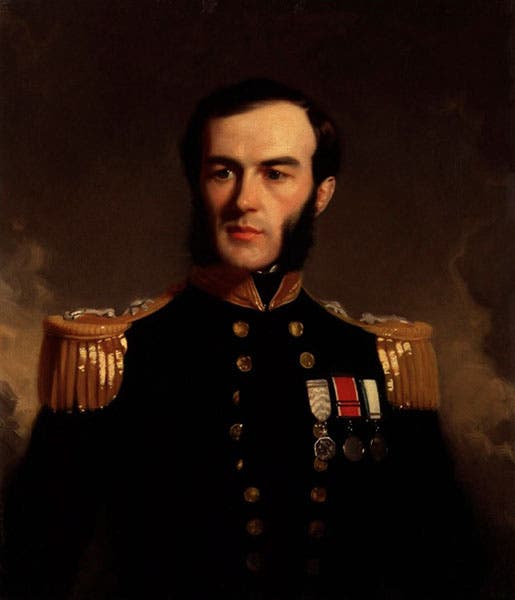
Portrait of Edward Augustus Inglefield, oil on canvas, by Stephen Pearce, 1853, National Portrait Gallery, London (npg.org.uk)
Inglefield joined the Franklin search in 1853. Edward Belcher, one of the least competent commanders to ever enter Baffin Bay, had been sent out in 1852 with 5 ships – the Belcher squadron – and had reached what was now familiar territory, Beechey Island and Barrow Strait, right in the middle of the archipelago. In addition to searching for Franklin, they were also looking for signs of HMS Investigator, which had entered the archipelago from the west in 1851 and had also gone missing.

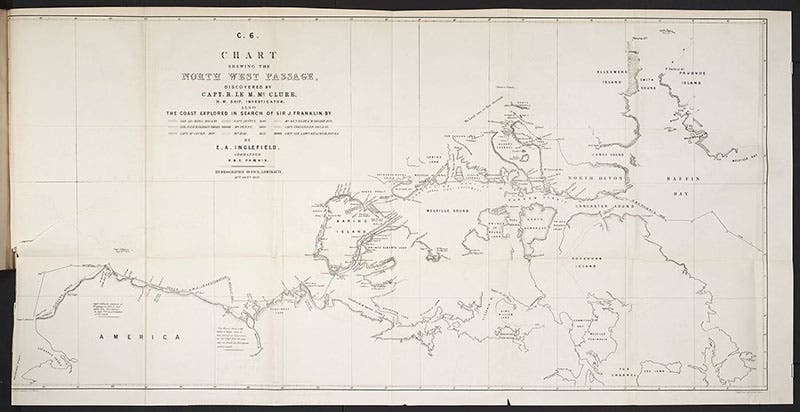
First map of a Northwest passage, by Edward Augustus Inglefield, dated Oct. 14, 1853, Papers Relative to the Recent Arctic Expeditions in Search of Sir John Franklin and the Crews of H.M.S. “Erebus” and “Terror” (an Arctic Blue Book), bound in at end, 1854 (The Linda Hall)
Inglefield in 1853 was given command of a screw-driven steamship, HMS Phoenix, and ordered to resupply the Belcher squadron. There is a painting of the Phoenix and two of its tenders in the National Maritime Museum, Greenwich, painted by Inglefield himself (first image). While the Phoenix was in Barrow Strait, the first of the crew of the Investigator, frozen in since 1851 at Banks Island, began to show up, specifically Samuel Gurney Cresswell, second in command on the Investigator, and a skilled artist himself. Inglefield brought Gurney and a few other crew members back to England in 1853, and by one definition, they (but not Inglefield) had completed a Northwest passage, although partly on foot and in two different ships.

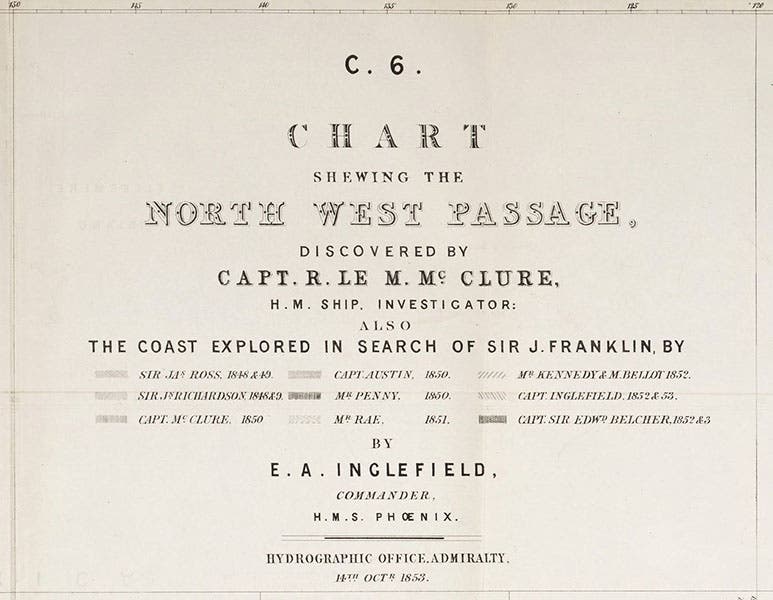
Title caption, detail of map of a Northwest passage, by Edward Augustus Inglefield, Papers Relative to the Recent Arctic Expeditions in Search of Sir John Franklin and the Crews of H.M.S. “Erebus” and “Terror” (an Arctic Blue Book), bound in at end, 1854 (The Linda Hall)

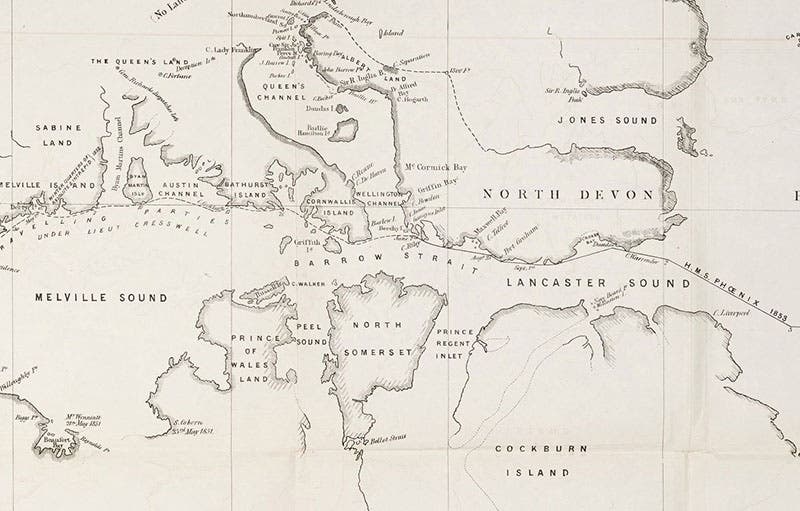
Barrow Strait and Beechey Island, detail of map of a Northwest passage, by Edward Augustus Inglefield, Papers Relative to the Recent Arctic Expeditions in Search of Sir John Franklin and the Crews of H.M.S. “Erebus” and “Terror” (an Arctic Blue Book), bound in at end, 1854 (The Linda Hall)
Inglefield lost no time in compiling a map of the Arctic archipelago, showing the track of the Investigator, the sledge journeys across the ice to safety, and the journey home. The map was published in one of the Arctic Blue Books – collections of letters, orders, and discovery reports that were regularly printed up by the Admiralty. We have one of 1854 that contains the first map of a completed Northwest passage, compiled by Inglefield, and it is our featured attraction of the day (third image plus details, images four to six). The map is folded up into the back of the Blue Book; when spread out, it is about 40” by 20”.


Baring Island (now Banks Island), showing various winter locations of HMS Investigator, detail of map of a Northwest passage, by Edward Augustus Inglefield, Papers Relative to the Recent Arctic Expeditions in Search of Sir John Franklin and the Crews of H.M.S. “Erebus” and “Terror” (an Arctic Blue Book), bound in at end, 1854 (The Linda Hall)
Cresswell was the first to complete the passage, but he did not get the reward; instead, that went to Robert McClure, commander of the Investigator, who came home the next year on the sole remaining ship of the Belcher squadron (Belcher abandoned the other four ships, frozen in the ice, much to the displeasure of his captains). So far as we know, McClure did not share any of his £10,000 with his crew, who completed the passage with him, or with Cresswell, who did it first.


Blue paper cover, Papers Relative to the Recent Arctic Expeditions in Search of Sir John Franklin and the Crews of H.M.S. “Erebus” and “Terror” (an Arctic Blue Book), 1854 (The Linda Hall)
We told the entire story of the search for Franklin and a Northwest passage in our exhibition, Ice: A Victorian Romance, in 2008-09. You can retrace it by starting here and moving forward through the next 15 exhibit items.


First several paragraphs of Edward Inglefield’s report on the first successful Northwest passage, Papers Relative to the Recent Arctic Expeditions in Search of Sir John Franklin and the Crews of H.M.S. “Erebus” and “Terror” (an Arctic Blue Book), p. 14, 1854 (The Linda Hall)
Inglefield was one of many Arctic commanders who had his portrait painted by Stephen Pearce (second image). His portrait is now in the National Portrait Gallery, London.
William B. Ashworth, Jr., Consultant for the History of Science, Linda Hall Library and Associate Professor emeritus, Department of History, University of Missouri-Kansas City. Comments or corrections are welcome; please direct to ashworthw@umkc.edu.