Scientist of the Day - Ernst Boris Chain

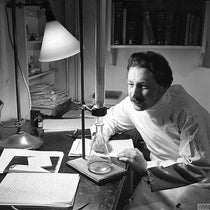
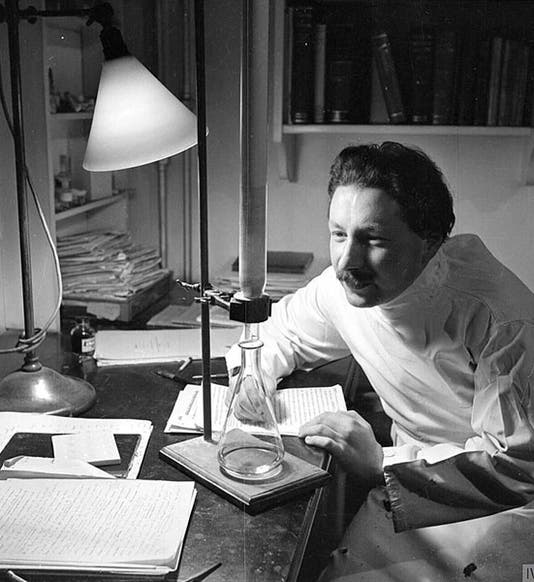
Portrait of Ernst Boris Chain in his lab at Oxford, undated photograph (Wikimedia commons)
Ernst Boris Chain, a German/British biochemist, died Aug. 12, 1979, at the age of 73. Chain was Jewish, born in Berlin, and he sensed, when Hitler came to power, that his days in Germany were numbered. He left Germany for England in early April of 1933, some days before the Law for the Restoration of the Civil Service was enacted, which removed all academic Jews from their faculty positions in Germany.
In England, Chain was assisted by J.B.S. Haldane, who helped him find a position in a London hospital. Soon he returned to school, getting a PhD in biochemistry at Cambridge, under Gowland Hopkins, who had received the Nobel Prize in Physiology/Medicine in 1929 , for his discovery of vitamins. Chain wound up at Oxford, where he found himself working with an Australian, Howard Florey, on a variety of projects, including a search for naturally occurring anti-bacterial agents. Chain became a British citizen in 1939.

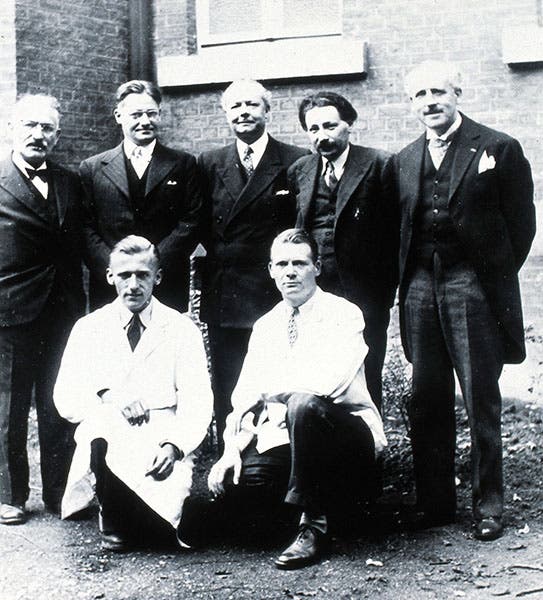
Members of the British penicillin team, including Ernst Chain (second from right, back row) and Howard Florey (second from left, back row), photograph, 1940s, Wellcome Collection (wellcomecollection.org)
Back in 1928, a Scot named Alexander Fleming, working at St. Mary's Hospital in London, had discovered, quite by accident, that the bread mold Penicillium inhibits bacterial growth. He cured a few eye infections with his penicillin, as he called the mold extract, but he was unable to determine its structure, figure out how it works, or produce very much of it. He did not think penicillin could ever be mass-produced, and he gave up working with it in the 1930s.

Tanks used to prepare penicillin in early attempts at mass production, Oxford, undated photograph, Wellcome Collection (Wikimedia commons)
Chain and Florey, at the School of Pathology at Oxford, with the help of a graduate student, Norman Heatley, began to work with penicillin in 1940. There was a war on, with thousands of men dying of infections, and an effective antibiotic would be a godsend. The trio discovered which species of Penicillium produced the most penicillin and what nutrients worked best; they found its chemical structure; and most importantly, they learned how to make it in large batches in tanks (third image). Unable to set up a penicillin "factory" in war-torn England, they came to the United States and were able to co-opt a factory of incubating tanks in Peoria, Illinois, and soon mass quantities of penicillin, hundreds of thousands of doses, were available, just in time for D-Day. Penicillin proved as effective as everyone hoped, and thousands of infections, most potentially lethal, were stopped in their tracks by the new miracle drug.
.jpg#/media/File:Sir_ERNST_CHAIN_1906-1979_Biochemist_and_Developer_of_Penicillin_lived_here_(23248826579).jpg)
Blue plaque for Ernst Chain, at his home, 9 North View Wimbledon Common, London (Wikimedia commons)
Chain, Florey, and Fleming received the Nobel Prize in Medicine in 1945 for the discovery of penicillin. Since Nobel prizes can have no more than three recipients, young Heatley was left out, as was indeed the rest of the team at Oxford and in Peoria. At first, Fleming was gracious about his role and did not try to claim credit for what Chain and Florey had been able to accomplish, after he had given up. But as time went on, he began to place himself more and more in the limelight, and gradually the "Fleming myth" was built up, so that school-children learned that Fleming had discovered penicillin and saved millions of lives, and Chain, Florey, and Heatley were left out of the story completely. It is one of the great miscarriages of hero justice, and as with most myths, there is not much anyone can do about it, except shout into the wind now and then, as I like to do regularly. This is our third post on the discovery of penicillin; only Heatley awaits his due.

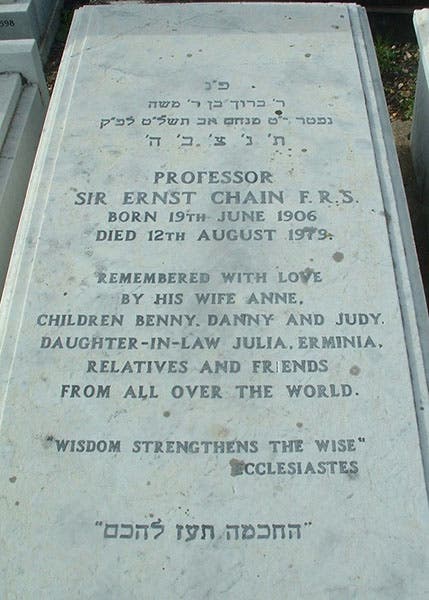
Tombstone of Ernst Boris Chain, Bushey Jewish Cemetery, Watford Borough, Hertfordshire, England (findagrave.com)
Chain worked at Imperial College, London, until his retirement, and he died in Castlebar, Ireland, on this day in 1979. He is buried in Bushey Jewish Cemetery, Watford Borough, Hertfordshire, England (last image).
William B. Ashworth, Jr., Consultant for the History of Science, Linda Hall Library and Associate Professor emeritus, Department of History, University of Missouri-Kansas City. Comments or corrections are welcome; please direct to ashworthw@umkc.edu.