Scientist of the Day - Giovanni Battista Riccioli

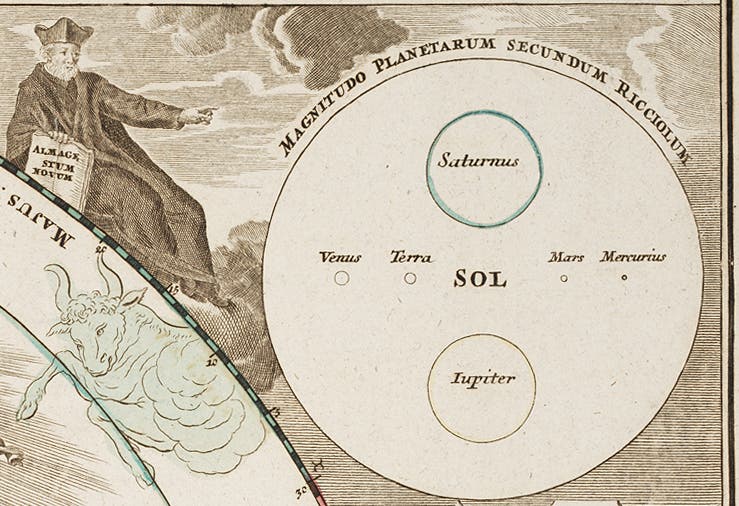
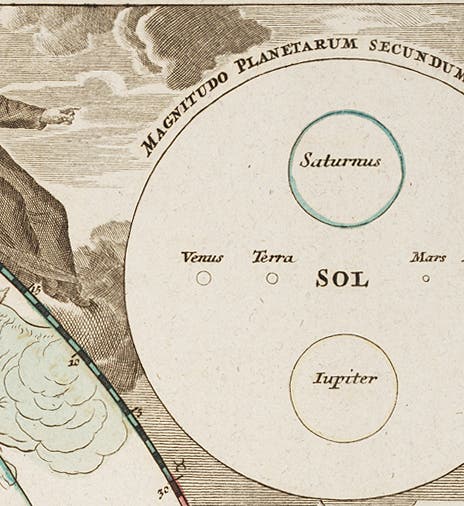
Portrait of Giovanni Battista Riccioli, detail of a cosmological diagram by Johann Doppelmayr, depicting the relative sizes of the planets, Atlas coelestis, Johann Doppelmayr, plate 3, 1742 (Linda Hall Library)
Giovanni Battista Riccioli, an Italian Jesuit astronomer, was born on Apr. 17, 1598, in Ferrara. After joining the Jesuit order, he studied theology at Parma and taught there in the 1630s. But he also set up an observatory at Parma and pursued astronomy with as much vigor as theology. When he was reassigned to Bologna, it was to the faculty of theology, but officials eventually relented and allowed him to pursue his passion, which was astronomy.

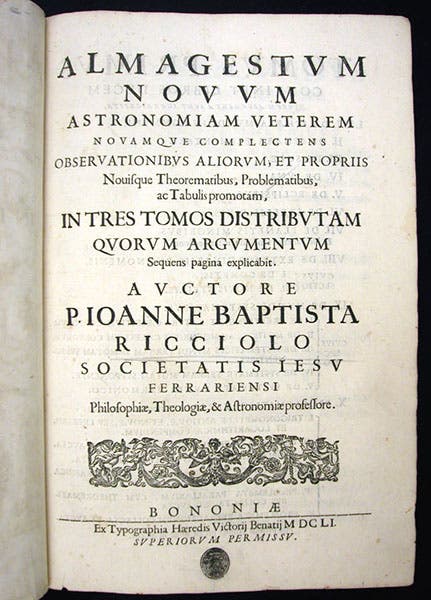
Title page, Almagstum novum, by Giovanni Battista Riccioli, 1651 (Linda Hall Library)
Riccioli made many observations on his own, especially of the Moon, but like many Jesuits (such as Athanasius Kircher), he liked to gather information from others and sift through it. He corresponded with many foreign astronomers, and in 1651, he issued the first volume of an astronomical encyclopedia called Almagestum novum (New Almagest), running some 1500 folio pages. Our copy, like most copies, is bound in two volumes, but the two correspond to only one of the three volumes mentioned on the title page (second image). The other two volumes were never published. But still, it was the most up-to-date astronomical handbook of the century, and if you wanted to find the latest views of the Moon, or sunspots, or the planets, it was the perfect source. And if you wanted to find all the arguments for and against the motion of the Earth, you also need look no further than Ricciioli’s compendium.

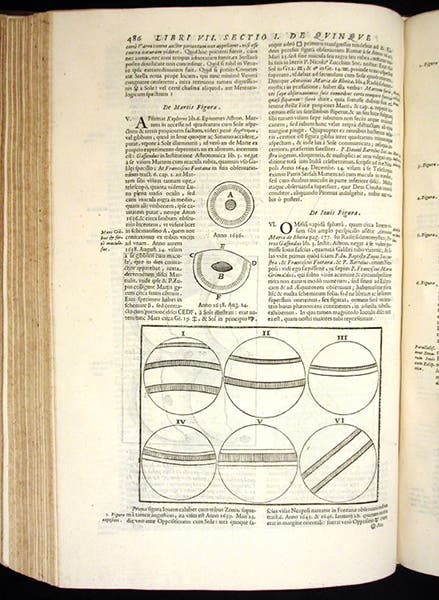
The faces of Jupiter (bottom) and Mars, according to Francesco Fontana, Almagstum novum, by Giovanni Battista Riccioli, vol. 1, p. 486, 1651 (Linda Hall Library)
It was in this work that Riccioli presented a new map of the Moon, drawn by his colleague Francesco Grimaldi, with all the features labeled with a new lunar nomenclature, devised by Riccioli, and still in use; the Sea of Tranquility first appeared on this map. We discussed and illustrated the Riccioli-Grimaldi lunar map in an early post on Riccioli.

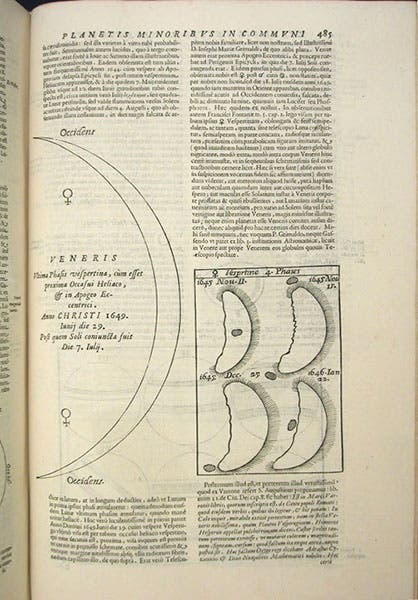
The faces of Venus, according to Francesco Fonana (right), and a recent observation, perhaps by Riccioli (left), Almagstum novum, by Giovanni Battista Riccioli, vol. 1, p. 485, 1651 (Linda Hall Library)
But Riccioli also showed views of all the planetary bodies, the best he had access to, and we thought we would offer some of those images today, since they are not reproduced as often as the moon map.

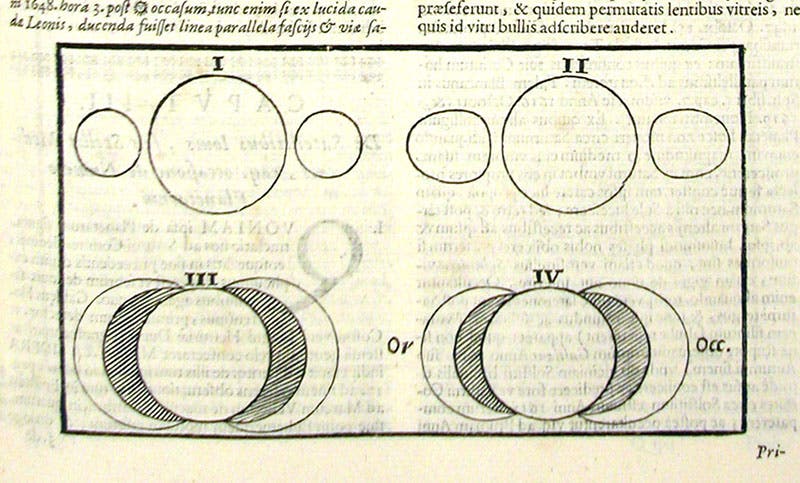
The faces of Saturn, according to a variety of observers), Almagstum novum, by Giovanni Battista Riccioli, vol. 1, p. 487, 1651 (Linda Hall Library)
One of the first astronomers to look for detail in the faces of the planets was Francesco Fontana of Naples, who saw marks on Mars, Jupiter, and Venus, and who published his drawings in 1646. Riccioli was well aware of them, and he included most of them in his New Almagest (third and fourth images). All of the details Fontana saw were spurious, the product of the optics of his telescope, but in 1651, that's all there were. Riccioli had access to one recent observation of Venus – it might have been his own – in which he saw none of the features Fontana saw (fourth image). You can see several of Fontana’s original woodcuts in our post on Fontana. Saturn had been observed by lots of people, who saw the planet with handles, or with small moons (fifth image). No one yet saw rings. That would come with the work of Christian Huygens in 1659.

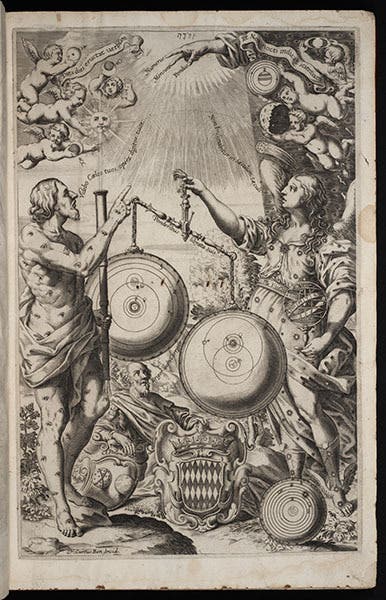
The “Weighing of World Systems,” engraved frontispiece, Almagstum novum, by Giovanni Battista Riccioli, vol. 1, 1651 (Linda Hall Library)
The single most recognizable engraving in Riccioli's New Almagest is the frontispiece, which presents a marvelous allegorical scene in which the Copernican world system is weighed against a modified system proposed by Tycho Brahe, and loses (sixth image). Riccioli was a Jesuit and by faith had to deny the motion of the Earth. We discussed this frontispiece in more detail in a second post on Riccioli.
There is still the matter of Riccioli's inquiry into cosmology to discuss, and his 126 arguments for and against the motion of the Earth. We shall look into this fascinating subject at a future time.
William B. Ashworth, Jr., Consultant for the History of Science, Linda Hall Library and Associate Professor emeritus, Department of History, University of Missouri-Kansas City. Comments or corrections are welcome; please direct to ashworthw@umkc.edu.