Scientist of the Day - Hal Laning

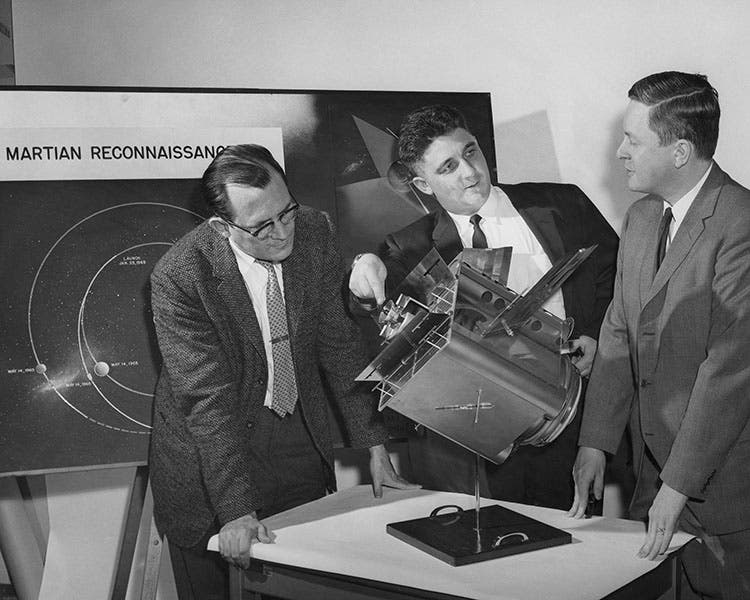
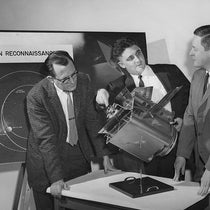
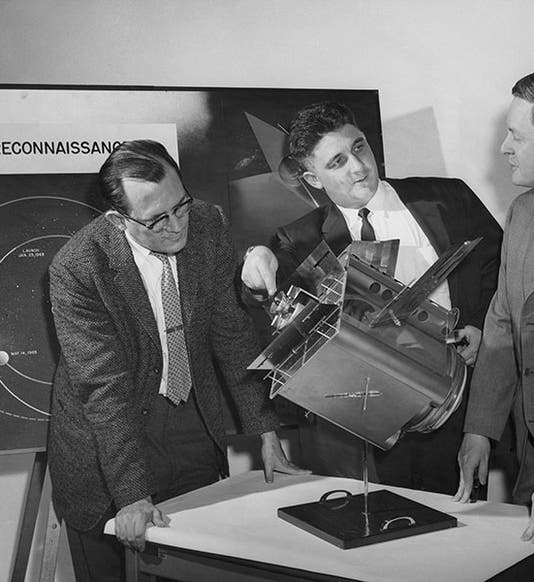
Hal Laning (left), Milt Trageser, and Dick Battin at MIT’s Instrumentation Lab, with their Mars probe of 1959 (wehackthemoon.com)
J. Halcombe Laning, Jr., an American computer software engineer known as Hal Laning, died on May 29, 2012, at the age of 92. Laning worked for the Instrumentation Lab (IL) at MIT, which was established by Charles Stark Draper to develop tracking systems for aircraft gunners during World War 2 and afterwards specialized in inertial guidance systems for ballistic missiles such as Polaris, capable of guiding itself from submarine launch to target. Laning, who helped develop the program for the MIT computer Whirlwind in 1952, the world's first real-time computer, played a major role in the success of Polaris, showing that with proper computer design and programming, a missile, using gyroscopes and accelerometers, could fly itself to its target with no outside input.

Telegram of Aug. 9, 1961, from NASA to MIT IL, announcing that they had been awarded the contract for the Apollo guidance system and computer (Wikimedia commons)
Laning and two others at MIT IL then developed a Mars probe that would use an inertial guidance system and an onboard computer to take a spacecraft on a flyby to Mars (first image). The probe was never built, but Laning leaned a lot about computers and guidance systems while working on it. So when NASA, about to receive its Man on the Moon mandate from President Kennedy in 1961, went looking for a guidance system, and a guidance computer, for its Apollo spacecraft, it naturally went straight to the IL at MIT, and to Hal Laning.

Apollo Guidance Computer (left) and the DSKY input module (Wikimedia commons)
Laning did not design the Apollo Guidance Computer (AGC), which was the first digital computer small enough to fit in a spacecraft, able to do so because it utilized newly invented integrated circuits. Most of the programing was hard-wired in, but Laning implemented higher level controls, especially his Executive program, that established priorities for running programs, so that what absolutely needed to get done, got done, and lower-level tasks were ignored for the time being. He also required that if the computer ever locked up or overloaded, it could be rebooted with no data or program loss. This was all new to software engineering.
Laning's foresight paid off during the lunar landing of Apollo 11 on July 20, 1969. The computer was being overwhelmed with data from a rendezvous radar that wasn't even supposed to be on, and it issued its famous "1201" and "1202" alarms, indicating data overload. There were 5 of these alarms, and the LEM computer rebooted instantly each time, with no radar data loss, giving priority to the landing sequence and ignoring everything else. The landing proceeded as if nothing unusual had happened, although hundreds of people at Mission Control in Houston were trying to survive panic attacks. Hal Laning had saved the day, one of the many unsung heroes of the Apollo 11 mission.
Hal Laning was born in Kansas City, but he was buried in Newton, Mass, where there is a small gravestone, with no mention of his importance for Apollo 11. I think he needs a monument here that does so.
William B. Ashworth, Jr., Consultant for the History of Science, Linda Hall Library and Associate Professor emeritus, Department of History, University of Missouri-Kansas City. Comments or corrections are welcome; please direct to ashworthw@umkc.edu.