Scientist of the Day - James Geddes

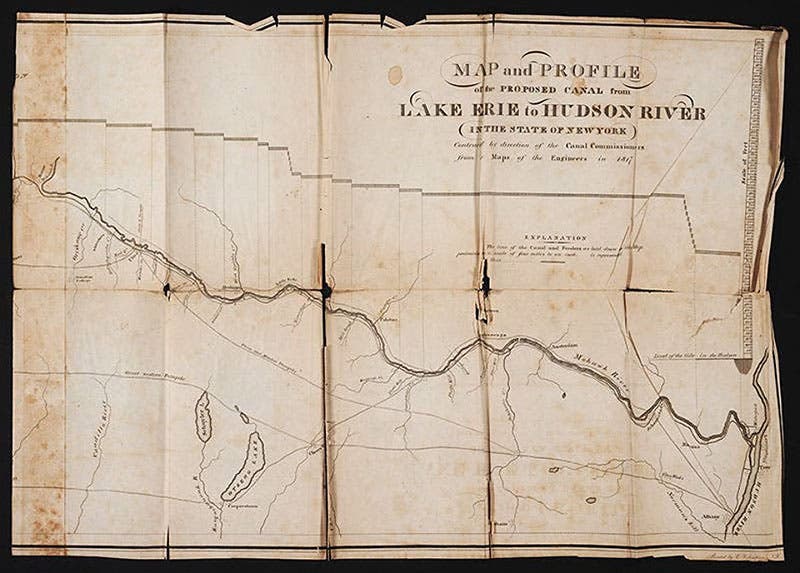
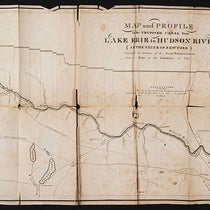
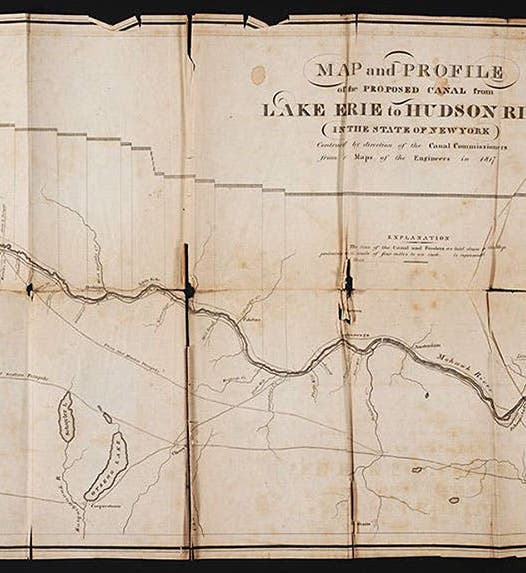
Segment of proposed map of Erie Canal route, showing section from Hudson River to Utica, from Official Report of the Canal Commissioners, 1817; the ”lockage” or drop in elevation is shown in a line graph at the top (The Linda Hall)
James Geddes, an American surveyor and engineer, was born on July 22, 1763, in Carlisle, Pennsylvania. Although he is usually described as a surveyor and engineer – indeed, I just did so – he was trained in neither discipline; that was an impossible education to get in the young republic of the United States. He was rather an entrepreneur and manufacturer who established a salt industry along Onondaga Lake in central New York State, just northwest of Syracuse. He taught himself surveying because fellow businessmen and manufacturers were desperate to find a transportation connection with the rest of the world, since there were no navigable rivers in the area. A canal seemed to be the only option, except that no one in central New York knew anything about laying out a canal, or building one. So Geddes taught himself surveying and learned about canals. This started about 1805. He learned about "lockage," the total height difference along the length of a canal, which had to be accommodated by mechanical locks, which were very expensive.

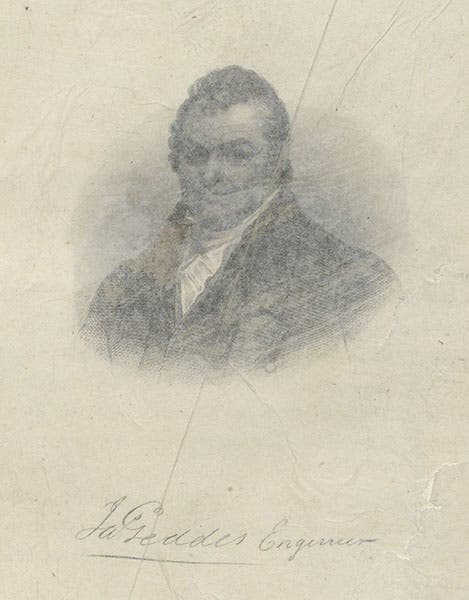
Portrait of James Geddes, taken through stuck tissue paper, from Lives and Works of Engineers, by Charles B. Stuart, 1871 (The Linda Hall)
Meanwhile, the State of New York was trying to persuade the Federal Government to finance a canal that would connect New York City, via the Hudson River, to the Great Lakes. The U.S. Congress was not interested, so Governor DeWitt Clinton took the lead in making a cross-state canal a state project. The first task of the Canal Commission was laying out a route, and for that task, James Geddes was put in charge. He is often referred to as Chief Engineer of the Erie Canal Project, but he was not. He was rather Chief Surveyor, who showed that a canal was feasible and laid out the route. The original intent was to connect with both Lake Erie and Lake Ontario. Geddes argued for a Lake Erie terminus only, or else the lockage to include Lake Ontario would be prohibitively expensive. The route followed by the eventual Erie Canal ran almost exactly along the route Geddes laid out (third image).

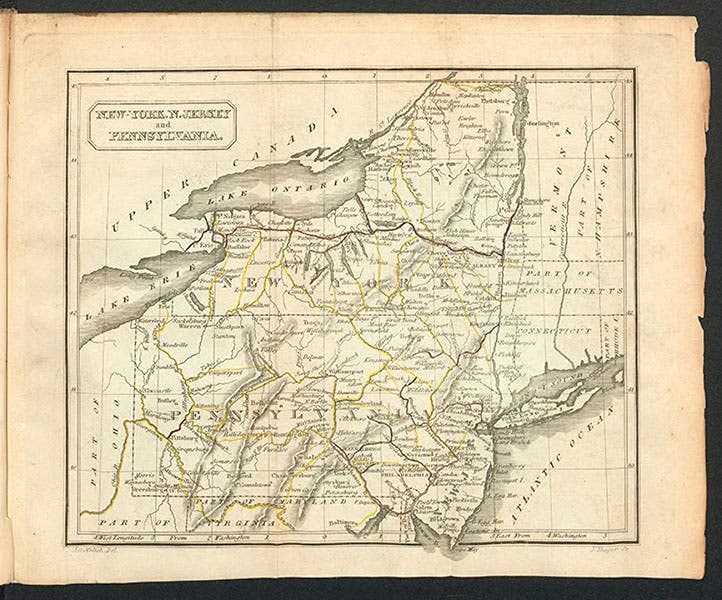
Map of New York State, with the completed Erie Canal in red, from A Connected View of the Whole Internal Navigation of the United States, 1826 (The Linda Hall)
When construction began in 1817, Geddes was one of five "Engineers" named to the Board (none were actually trained engineers), but he does not appear to have had a major role in building the canal. Instead Benjamin Wright took the lead, aided by a young trainee, Canvass White. The Erie Canal was completed in 1825. Geddes departed in 1822 to become Chief Engineer on the Ohio & Erie Canal for the State of Ohio. This was completed in 1827, connecting Lake Erie to the Ohio River, but it never had the commercial success of the Erie Canal, especially after the transcontinental railroad was completed in 1869.

A view of the Ohio & Erie Canal, James Geddes, Chief Engineer, photograph, 1902 (Wikimedia commons)
Geddes worked on several other canal projects in Maryland and Pennsylvania, but he also became a judge and a U.S. congressman, and his engineering days faded away. He settled down in Salina in central New York, where he died in 1838. Part of Salina subsequently became the town of Geddes, which is still there.

Another version of the portrait of James Geddes, from Lives and Works of Engineers (1871), by Charles B. Stuart, this one not taken through the tissue overlay (Wikimedia commons)
Our portrait of Geddes (second image) was taken from Lives and Works of Engineers (1871), by Charles B. Stuart, and if it looks odd, it is because the tissue-paper overlay has become stuck to the paper beneath and cannot be removed without tearing the wood engraving. So we photographed right through it. Interestingly, this cohesion did not occur with the other portraits in the book, one of which we used in another post (Canvass Wright). If you would rather see a sharper portrait of Geddes from the same source, I do not blame you, and can oblige, although this one is not a lot sharper, even without tissue paper (fifth image).

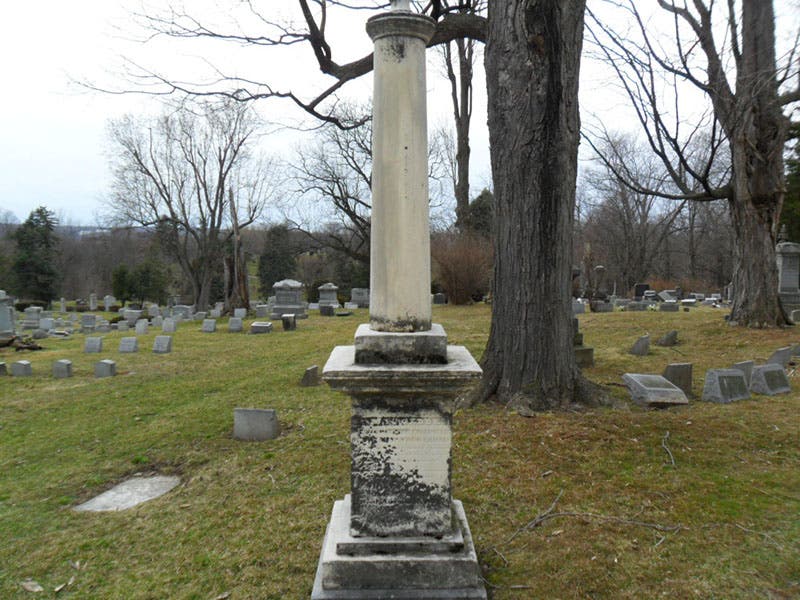
Tombstone of James Geddes, Oakwood Cemetery, Syracuse, Onondaga County, New York (findagrave.com)
James Geddes died on Aug. 19, 1838, at age 75, and was buried in Oakwood Cemetery, Syracuse, Onondaga County, New York. His tombstone is large but, at this distance, illegible (last image).
William B. Ashworth, Jr., Consultant for the History of Science, Linda Hall Library and Associate Professor emeritus, Department of History, University of Missouri-Kansas City. Comments or corrections are welcome; please direct to ashworthw@umkc.edu.