Scientist of the Day - Wilfrid Le Gros Clark

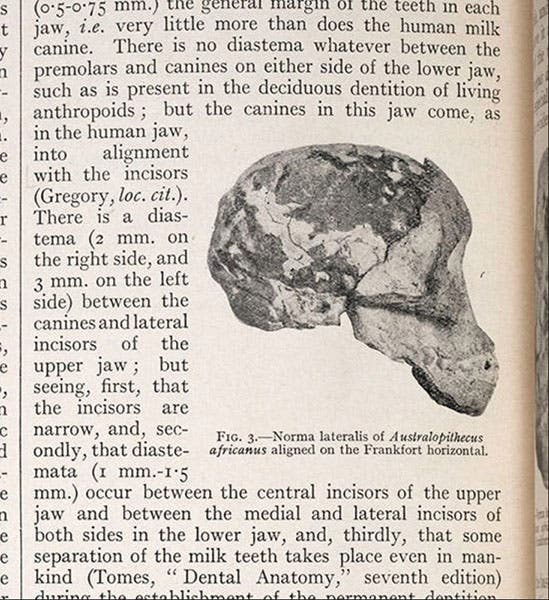
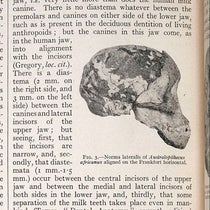
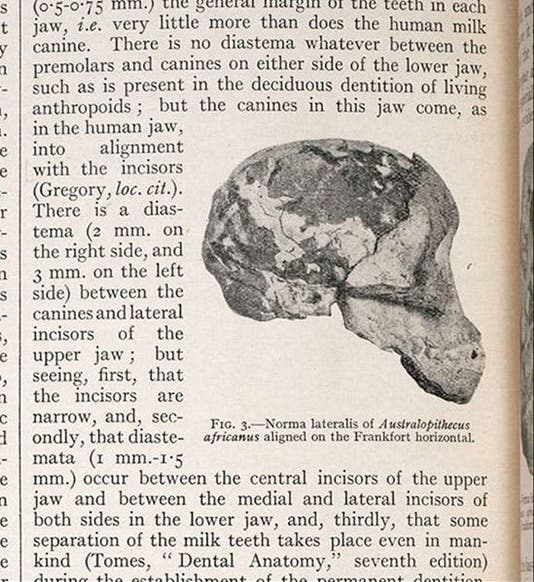
Side view of the Taung skull, with brain cast, detail of photograph from “Australopithecus africanus: The man-ape of South Africa,” by Raymond Dart, Nature, vol. 115, Feb. 7, 1925 (Linda Hall Library)
Wilfrid Le Gros Clark, a British anatomist, anthropologist, and primatologist, was born June 5, 1895. He studied medicine at St. Thomas Hospiral in Lambeth, London, and served in the Royal Medical Corps during World War I. He later served as a medical officer in Sarawak, which is where he became interested in the evolution of primates. He taught at St. Bartholomew's Hospital, then back at St. Thomas, and was finally appointed professor of anatomy at Oxford, where he taught until his death in 1971. He is usually indexed under “Clark” in the secondary literature, but in his own books he used “Le Gros Clark” as his last name, and we will respect his wish here.

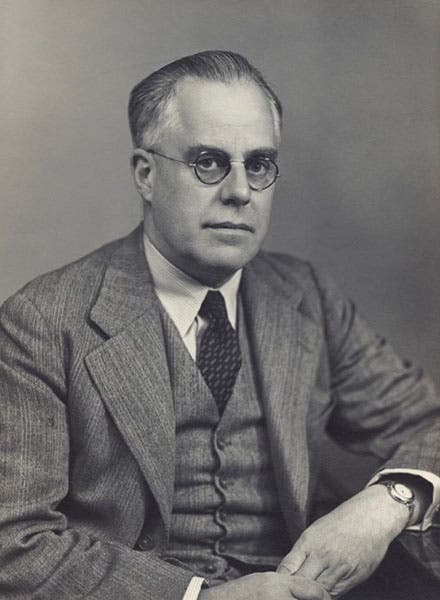
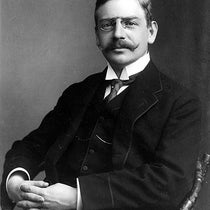
Portrait of Wilfrid Le Gros Clark, photograph by Walter Stoneman, 1949, National Portrait Gallery, London (npg.org.uk)
In 1924, Raymond Dart had found a new kind of hominid in South Africa, which he thought was a possible human ancestor; he named it Australopithecus. In the 1930s and 40s, Robert Broom found additional hominid fossils in South Africa, a smaller one he named Plesianthropus, and a large, robust version that he called Paranthropus. He later realized that his Plesianthropus was really an adult Australopithecus, especially after he found an exceptionally fine skull, nicknamed “Mrs. Ples,” in 1947 (third image). His specimens and Dart's were loosely termed "australopithecines," since they had much in common, and Broom thought it likely that one of them was the ancestor of Homo sapiens (as you can tell by his names, which mean "near-human" and "really-near human", respectively).
Dart's original specimen was the skull of a child, found at a South-African quarry named Taung, and so usually referred to as the Taung skull (first image). It had a small brain, but human-like dentition, and the foramen magnum, the opening that admits the spinal cord, was on the bottom of the skull, suggesting a upright posture, and possibly bipedalism. Broom would find "postcranial" remains, such as leg nones and pelvises, that further suggested that Australopithecus was a bipedal hominid. Both men thought it likely that human origins were to be found in Africa, not Europe or Asia. This was a new and unprecedented idea in the 1920s and 30s.

Four views of the skull of “Mrs. Ples,” STS 5, an adult Australopithecus found by Robert Broom in 1947 at Sterkfontein cave, Ditsong National Museum of Natural History, Pretoria, South Africa (Wikimedia commons)
Back in merrie olde England, no one in the anthropological establishment was paying much attention to these South Africans and their claim that Africa was the cradle of humankind. After all, England had its Piltdown man, Eoanthropus, who was evidently far preferable to Australopithecus as a human forebearer, since it had a large brain. Le Gros Clark, who was the anatomical expert in the crowd, initially agreed with his English colleagues and regarded Australopithecus as an ape rather than a hominid, and he held that opinion up until 1945. Until then, Dart and Broom had few defenders in England.
But when World War II ended, Le Gros Clark took the opportunity to travel to South Africa and look at Broom’s and Dart’s fossils firsthand, and he changed his mind. These were hominid fossils after all. Broom published the first major synthesis of the South African discoveries in 1946, and Le Gros Clark reviewed his book in Nature, praising Broom (then 80 years old) for his “unequalled … experience and reputation”, and pleading for his colleagues to recognize his “magnificent contributions.” Le Gros Clark was the first English anthropologist to defend Dart and Broom and to argue that Australopithecus was a much better candidate for an early human ancestor that anything found in Europe or Asia. The opposition was fierce, but Le Gros Clark’s arguments were well-based in anatomy and hard to refute. Thanks largely to his efforts, Australopithecus was accepted as an early hominid (we would now say hominin) by the 1950s. It did not hurt that Le Gros Clark, along with Kenneth Oakley, helped eliminate some of the competition, by demonstrating in 1953 that Piltdown Man was a fraud (see our post on Oakley). Eoanthropus was not an English ancestor after all.

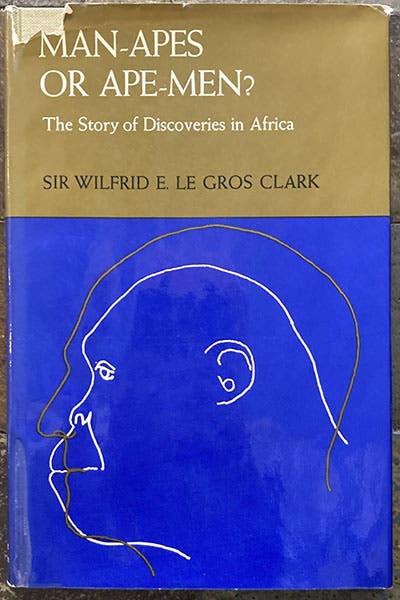
Dust jacket, Man-Apes or Ape-Men? The Story of Discoveries in Africa, by Wilfrid Le Gros Clark, 1967 (author’s copy)
In addition to his many technical articles, Le Gros Clark wrote several semi-popular books on human origins which are still well worth reading. The library has a copy of The Fossil Evidence for Human Evolution: An Introduction to the Study of Paleoanthropology (1955), and I own a nice copy of Man-Apes or Ape-Men? The Story of Discoveries in Africa (1967), with its original dust jacket.
William B. Ashworth, Jr., Consultant for the History of Science, Linda Hall Library and Associate Professor emeritus, Department of History, University of Missouri-Kansas City. Comments or corrections are welcome; please direct to ashworthw@umkc.edu.