Scientist of the Day - Donald Johanson

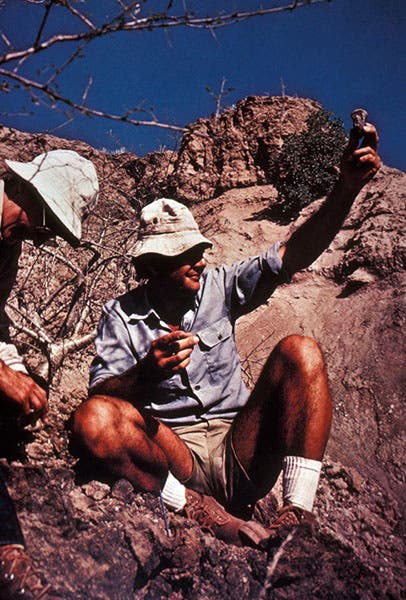
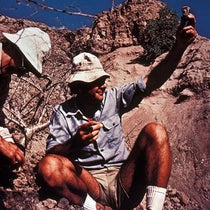
Donald Johanson in the field, Hadar, Ethiopia, November, 1974, photograph in Lucy: The Beginnings of Humankind, by Donald Johanson, foll. p. 96, 1981 (author’s copy)
Nov. 24, 1974, was a momentous day in the history of the search for human origins. On that day, a young anthropologist from Case Western Reserve University in Ohio, 31-year-old Donald Johanson, was about to wind up the field season at Hadar in the Afar Triangle region of Ethiopia. He decided to abandon the pile of paperwork competing for his attention and join his graduate student, Tom Gray, in a final walk-through of one area of their site. Johanson spotted a fragment of bone in the gravel, which he recognized as hominid, then another, and after summoning help from camp, dozens and dozens more, with no duplications, meaning all were from a single individual. This was Lucy, one of the best-known prehuman specimens ever found, and, it is believed, a human ancestor.

Dust jacket, Lucy: The Beginnings of Humankind, by Donald Johanson, 1981 (Wikimedia commons)
In those days, paleoanthropology in East Africa was ruled by the Leakey family – Mary Leakey, son Richard and his wife Meave, and the ghost of the patriarch of the family, Louis, who had passed away in 1972. Among them, they had discovered important specimens of early humans, such as Homo habilis, and protohumans, like Australopithecus africanus. But no one in 1974 had anything like Lucy, a skeleton that was 40% complete, the remains of a hominid with a small brain, standing perhaps three and a half feet tall, but fully bipedal. Johanson would claim her as a new species, Australopithecus afarensis. She walked East Africa about 3.2 million years ago, and she would make Johanson famous. He moved to Cal Berkeley in 1981, where he founded the Institute of Human Origins, which he later transferred to Arizona State University, where it continues to thrive. Lucy was returned to Ethiopia, where she sleeps in a vault in the National Museum of Ethiopia.

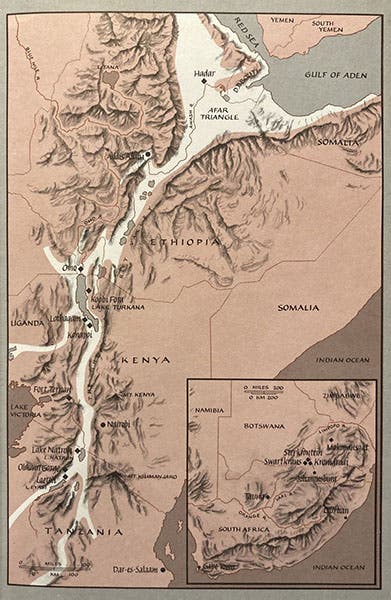
Location of Hadar in Ethiopia, in relation to East Africa, front endpaper of Lucy: The Beginnings of Humankind, by Donald Johanson, 1981 (author’s copy)
In 1981, Johanson teamed up with a veteran science writer, Maitland Edey, to write and publish Lucy: The Beginnings of Humankind. This was a book intended for the lay reader, trying to explain current ideas of human origins, as well Johanson's discoveries in Ethiopia and how they changed the picture. It was dramatic in its portrayal of the disagreements in interpretation between the Leakeys and Johansson, and it was a best seller, winning the National Book Award. It is still eminently readable, if you want to know what the life of a paleoanthropologist is like, and what gets them excited.
The bones of Lucy, Australopithecus afarensis, photograph in Lucy: The Beginnings of Humankind, by Donald Johanson, 1981 (Wikimedia commons)
In 2012, we had an exhibition at the Library, Blade and Bone: The Discovery of Human Antiquity, and Johanson came to Linda Hall to give a public lecture in conjunction with the exhibition (thanks to Eric Ward, in charge of public programming, who arranged this). I was fortunate to be able to join Johanson for an extended lunch, and he was a pleasant and congenial lunch companion, sharing details of his early life that did not appear in Lucy or his subsequent books, specifically about how he ended up in anthropology.

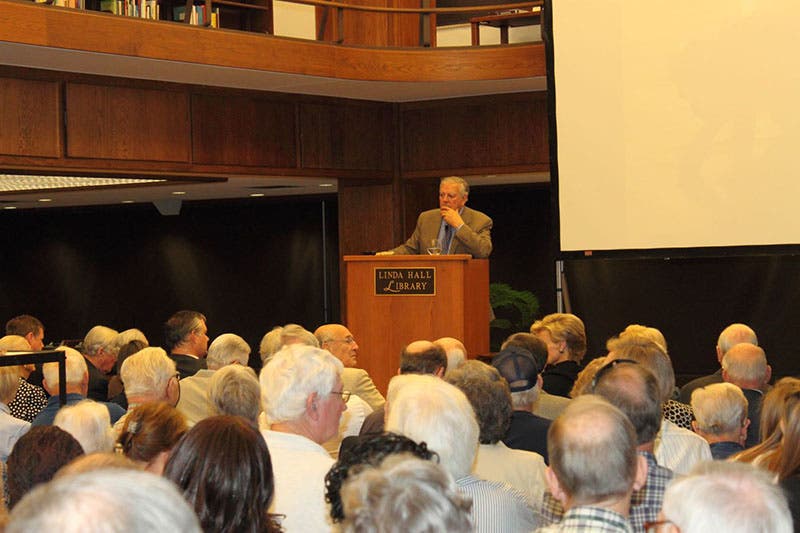
Donald Johanson answering questions after his talk at the Linda Hall Library in 2012 (Eric Ward)
Johanson was born on June 28, 1943, and grew up in Hartford, Connecticut, the son of Swedish immigrants. His father died when he was two, and his mother eked out a living as a cleaning lady. One day, when he was about 8 or 9 years old, Johanson met a man walking his dog in the park, and over time they struck up a friendship – the man even spoke Swedish, so he could converse with Johanson’s mother. Eventually, Johanson was invited to the man’s house, and the dog-owner turned out to be an émigré German scholar who was teaching anthropology at Hartford Theological Seminary. His name was Paul Leser, and he had fled Germany during the rise of Hitler, lived in Sweden for 6 years, and then travelled to the U.S, finally ending up in Hartford. He spoke to Johanson often about Africa – Leser was a specialist in African culture – and gave the young boy the run of his considerable library. The allure of Africa and the puzzle of human origins proved irresistible to Johanson, and the rest, as they say, is history.
I looked up Leser as best I could – he died in 1984, and is hardly remembered today, with no Wikipedia article. Yet in his kindness to a young boy, Leser did more for modern anthropology than dozens of his more famous colleagues. He, and other unheralded mentors like him, deserve our thanks, as we recall Johanson's famous discovery.

The replica of Lucy on display in the National Museum of Ethiopia, in Addis Ababa, with the original kept nearby in a secure vault (Wikimedia commons)
Johanson, now 83, is still active, and when Lucy was briefly paroled from confinement in 2025 and shipped to the Natural History Museum Abu Dhabi for that museum’s opening, Johanson was invited to attend and be reunited with his famous find. On this webpage, there is a brief 90-second video capturing that reunion.
William B. Ashworth, Jr., Consultant for the History of Science, Linda Hall Library and Associate Professor emeritus, Department of History, University of Missouri-Kansas City. Comments or corrections are welcome; please direct to ashworthw@umkc.edu.