Scientist of the Day - Edward Holden

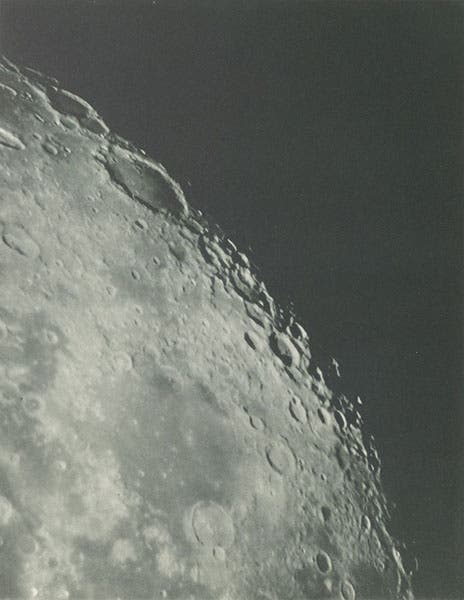
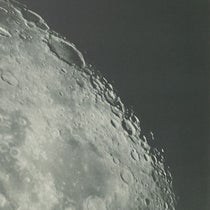
Plate 13, lunar surface, Observatory Atlas of the Moon, Lick Observatory, 1897 (The Linda Hall)
Edward Singleton Holden, an American astronomer, was born Nov. 5, 1846, in St. Louis. He studied at Washington University, receiving a B.S. in 1866, and then, oddly, attended West Point, where he studied astronomy, graduating in 1870. In 1873, he was hired by the U.S. Naval Observatory in Washingon, D.C., with Simon Newcomb, a gifted mathematical astronomer, in charge. Newcomb took a liking to young Holden, which, as we shall see, was not easy to do, and was later responsible for many of the upward steps in Holden's career. The Naval Observatory was then installing the largest telescope in the world, a 26-inch refractor built by Alvan Clark & Sons of Cambridge, Mass, and with it, in 1877, Asaph Hall discovered the two moons of Mars. Holden played no part in this, but he then claimed to have found a third Martian moon. However, his observations were imaginary and the orbit for his supposed moon was impossible, and Holden was left with egg on his face that he would never entirely remove. It turns out that Holden was not a very good astronomer and never would be. But he was a great organizer and a hard worker, and many people, like Newcomb, would support him.

Portrait of Edward S. Holden, photograph, Library of Congress, ca 1875 (Wikimedia commons)
Holden was hired by the University of Wisconsin to run their Washburn Observatory from 1881 to 1885, while he waited for the directorship of the new Lick Observatory to open up. This was being built from scratch on Mount Hamilton, just east of San Jose, California, and was to house a 36-inch Clark refractor, the largest in the world at the time. Holden impressed the trustees of the James Lick estate, and he was indeed hired in 1888 to head up the new institution. The Lick Refractor opened in 1889.

Lick Observatory, photograph (photogravure), 1900 (Wikimedia commons)
Holden’s tenure as director was a stormy one, although no one outside knew that for some years. Observing time on the giant refractor was precious, but Holden slotted two nights a week for himself, and several staff astronomers were relegated to a smaller 12- refractor and resented it. Holden seems to have irritated, and sometimes infuriated, nearly everyone who ever worked for him, especially those who saw that Holden did not really understand telescopes and their driving mechanisms, and took poor photographs with the 36-inch instrument. Complaints were lodged in writing by staff, and as they accumulated, and promising young astronomers left for happier positions elsewhere, the trustees finally stepped in, and Holden was removed from his position at the end of 1897. One of those astronomers who had left, James Keeler, was hired to replace Holden, and the Lick Observatory was suddenly a congenial place to work.

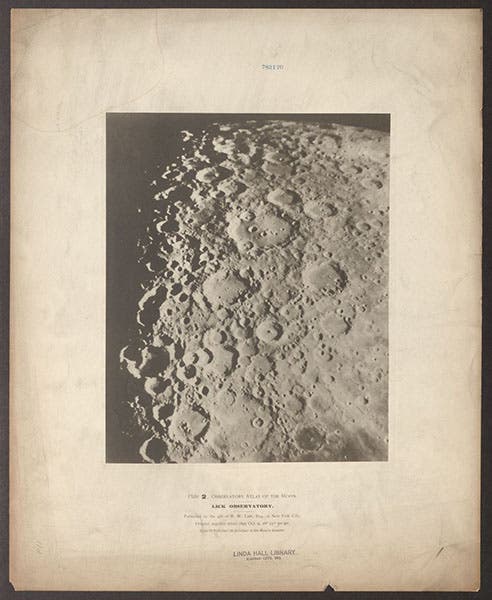
Plate 2, lunar surface, Observatory Atlas of the Moon, Lick Observatory, 1897 (The Linda Hall)
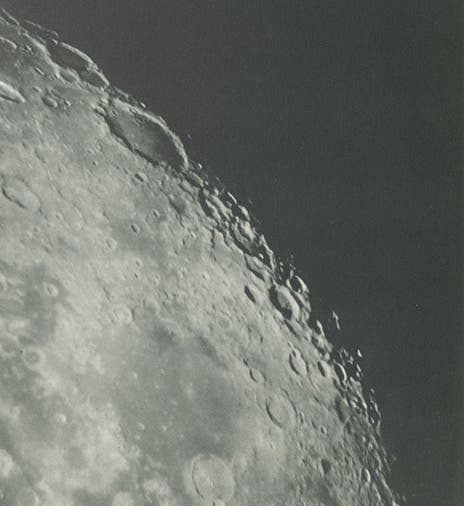
Holden's one redeeming piece of astronomical work was a photographic lunar atlas, published in 1897, just before he departed. It was incomplete, but the 19 photographs it contains, all taken with the 36-inch Lick refractor, are stunning to most viewers. They are all credited to Holden, and even though the best of them were probably done by assistants, and others, experts say, are blurry or out of focus, they are still impressive to view. They impressed me when we were organizing an exhibition of lunar maps and atlases back in 1989, and we included Holden's Observatory Atlas of the Moon as item 28 in The Face of the Moon, Galileo to Apollo. You can see the Holden entry here. Several other photos from the Atlas illustrate this post. The copy we have digitized is one that was mailed out plate by plate to the American Academy of Arts and Sciences in Boston, along with a printed explanation from Holden that was pasted on the back of plate 1 (fifth image).

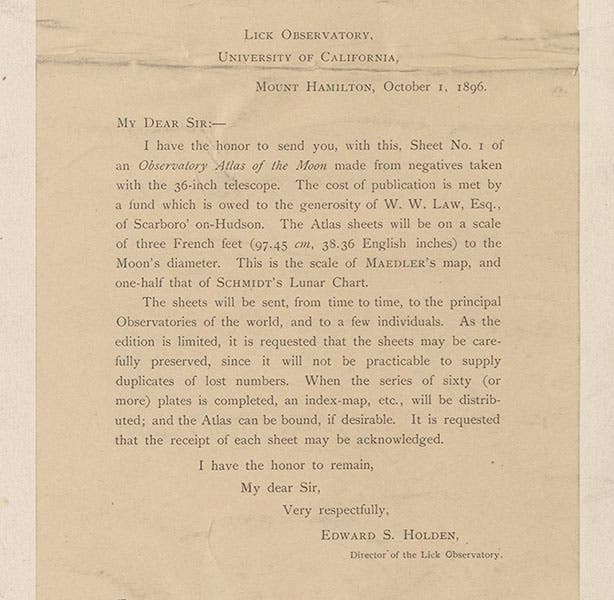
Printed explanation that accompanied plate 1, pasted on the back of our copy, Observatory Atlas of the Moon, Lick Observatory, 1897 (The Linda Hall)
When Holden was forced out at Mount Hamilton, he applied to be president of MIT, and librarian at Harvard, but those selection committees were apparently scared off by reports from California, and Holden, jobless, had to resort to writing for hire, just to put food on the table. Fortunately, he was a good writer, and well-read outside of astronomy, and he got by.

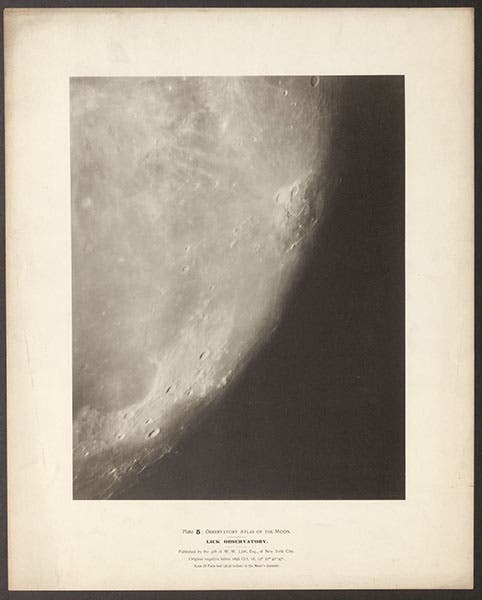
Plate 5, lunar surface, Observatory Atlas of the Moon, Lick Observatory, 1897 (The Linda Hall)
Then, in 1901, he snagged the job of librarian for West Point Military Academy. It seems like a long step down for the former director of a major observatory, but Holden loved it, and was apparently good at it, and he stayed in that position until his death on Mar. 26, 1914. He was buried in the West Point Cemetery.
William B. Ashworth, Jr., Consultant for the History of Science, Linda Hall Library and Associate Professor emeritus, Department of History, University of Missouri-Kansas City. Comments or corrections are welcome; please direct to ashworthw@umkc.edu.