Scientist of the Day - Eugene Wigner

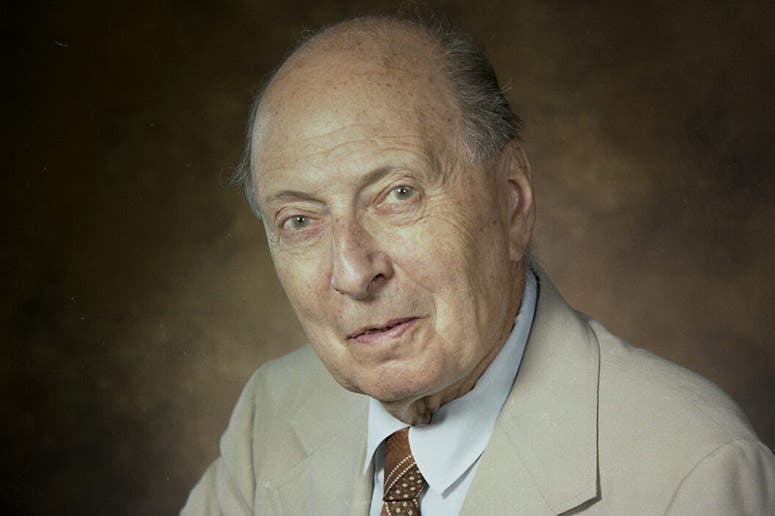
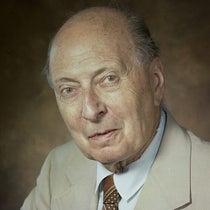
Portrait of an older Eugene Wigner, undated photograph (nobel.ornl.gov)
Eugene Wigner, a Hungarian/American physicist, was born on Nov. 17, 1902, in Budapest. He was one of five brilliant physicists, known as the Martians, who were born in Budapest, educated in Germany, and then fled to the United States with the rise of Hitler, where they proceeded to make major contributions to the war against the Nazis and to the advance of physics. The other four were Theodore von Karman, John von Neumann, Leo Szilard, and Edward Teller. We have profiled these four in previous posts; Wigner is the Last Martian.
Wigner studied first in Pest, then in Berlin, where he attended seminars with the likes of Albert Einstein and Werner Heisenberg, and was witness to the birth of quantum mechanics. He wrote a thesis for Michael Polanyi, who helped Wigner get his first few jobs, where Wigner made major contributions to laying the groundwork for the quantum revolution by invoking group theory, and introducing something called parity, which is conserved in all nuclear interactions. Much later (1963), Wigner would share a Nobel Prize for this work.
Princeton University in 1930 was trying to establish itself as a major player in physics, and they invited both Wigner and von Neumann to spend the spring semester at Princeton, an offer accepted, and one that Princeton would repeat for the next three years. When Hitler became Chancellor in 1933, both men stayed in the U.S, with von Neumann moving to the Institute for Advanced Study at Princeton.

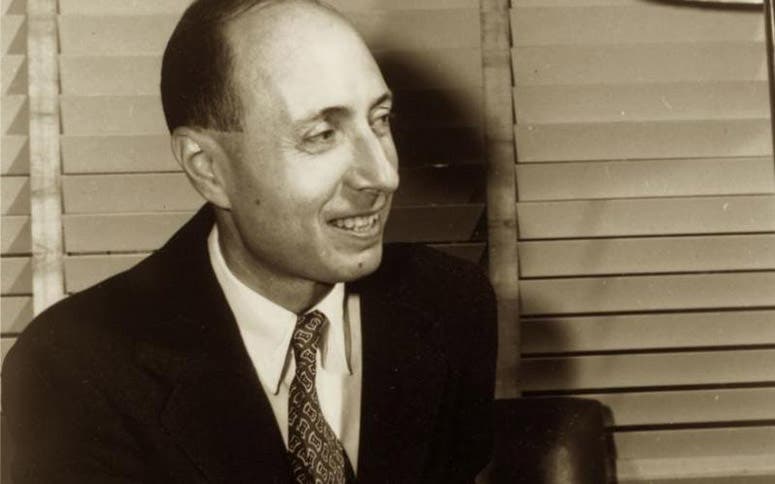
Portrait of a younger Eugene Wigner, at Princeton, undated photograph (nobel.ornl.gov)
Wigner is known for collaborating with Szilard in August of 1939, to persuade Einstein to write a letter to President Roosevelt, warning of the possibility of nuclear weapons, in the aftermath of the splitting of the atom 9 months earlier. Wigner and Szilard both made the trip to Peconic, Long Island, to Einstein’s summer home, and Wigner translated Einstein’s letter into English for Einstein’s signature. I told this story in our post on Szilard (unfortunately without mention of Wigner), and I stated that the Einstein letter was instrumental in launching the Manhattan project, because that is the textbook interpretation. But it seems that many historians think the letter might have been a hindrance – that the U.S. program to build nuclear weapons might have begun much sooner had the suggestion been made by American physicists, rather than by three emigrés, a German and two Hungarians. Indeed, it took the President's aides over two months to even deliver the letter to FDR.
During the War, Wigner was part of the Manhattan Project, helping to design the nuclear reactors for the Hanford site that were used to make plutonium for the crew at Los Alamos. After the war, he actually left Princeton to direct research at the new Oak Ridge National Laboratory (formerly the Clinton Laboratory) in Tennessee, but he soon tired of government bureaucracy and returned to academic life at Princeton, and he was no doubt pleased with the recognition that came with the Nobel Prize in 1963. Like many physicists, Wigner tried to turn himself into a philosopher in his later years, not very successfully, in my opinion, but he did publish a collection of his scientific essays, Symmetries and Reflections (1967), and much later, his Recollections (1992), if you want to see for yourself. Wigner died on New Year's Day, 1995, at the age of 92.
There is a dearth of portraits of Wigner – he was not especially photogenic – and I could find none at all of Wigner with any of the other Martians, or with Einstein, with whom he took walks on a regular basis at Princeton. As for the term "Martians," no one knows its exact origins. It is said to have been used as a joke at Los Alamos, the gist being that five Martians, smarter than humans, had landed in the U.S., and to disguise themselves, they spoke Hungarian. Whatever its origin, it has been used in the titles of several books about the Hungarian expatriates.
There is an intelligent and sympathetic account of Wigner, 20 pages long, in The Genius of Science: A Portrait Gallery of Twentieth-Century Physicists, by Abraham Pais (2000), pp. 330-51. We have all the books mentioned here in our library.
William B. Ashworth, Jr., Consultant for the History of Science, Linda Hall Library and Associate Professor emeritus, Department of History, University of Missouri-Kansas City. Comments or corrections are welcome; please direct to ashworthw@umkc.edu.