Scientist of the Day - Walther Hermann Ryff

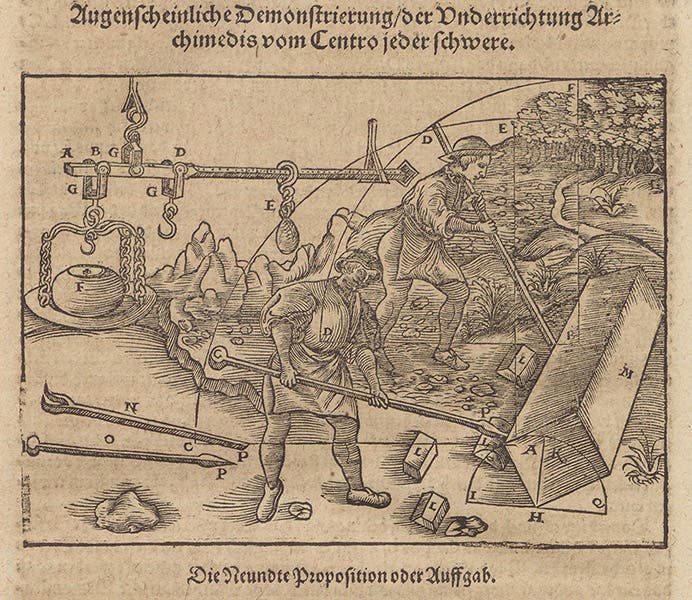
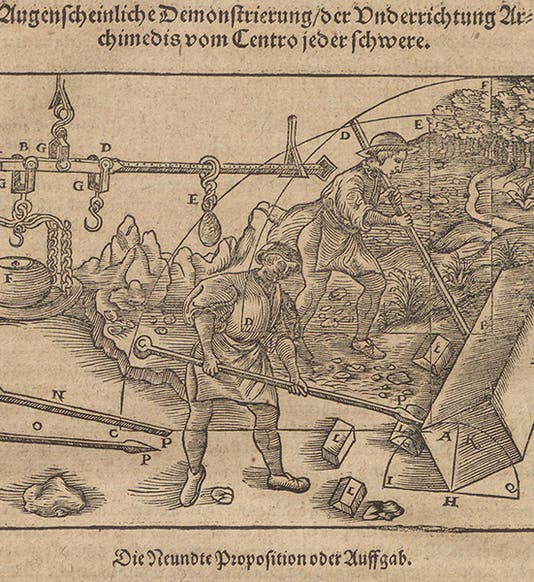
Levers in use according to the law of Archimedes, woodcut, Bawkunst, oder, Architectur, by Walther Hermann Ryff, 3rd ed., p. 526, 1582 (The Linda Hall)
Walther Hermann Ryff, a German writer about surgery, architecture, and machines, was born about 1500 in Strasbourg, and died on Sep. 29, 1548, in Mainz. He also spent time as town physician in Nuremberg. Practically nothing is known about Ryff for certain, except that he wrote and published enough books for ten men. His Great Surgery (in German) was his best known and most influential work, going through at least 4 editions. He also translated the work of the ancient Roman Vitruvius, called De architectura, into German in 1548, and he published books on pharmacy, anatomy, and even cooking. But we have none of these in our collections.

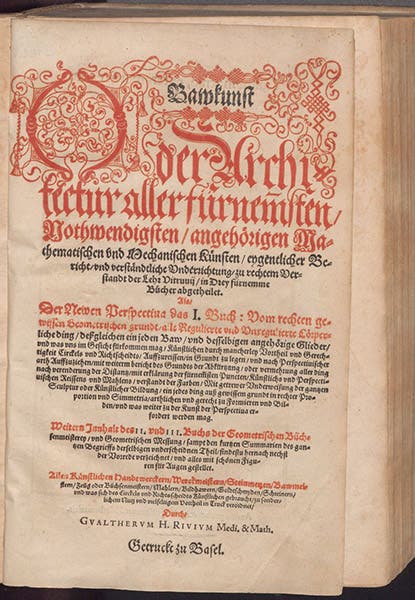
Title page, Bawkunst, oder, Architectur, by Walther Hermann Ryff, 3rd ed, 1582 (The Linda Hall)
We only have one of Ryff's publications, but it is a beauty, a tall folio bound in vellum called Bawkunst, the Art of Building, a third edition, printed in 1582. It is hard to know how it is related to his edition of Vitruvius. It seems to be more than a translation, for there are sections, for example, on ballistics, that do not seem Vitruvian. But without having the two books side by side on the table, it is hard to know.

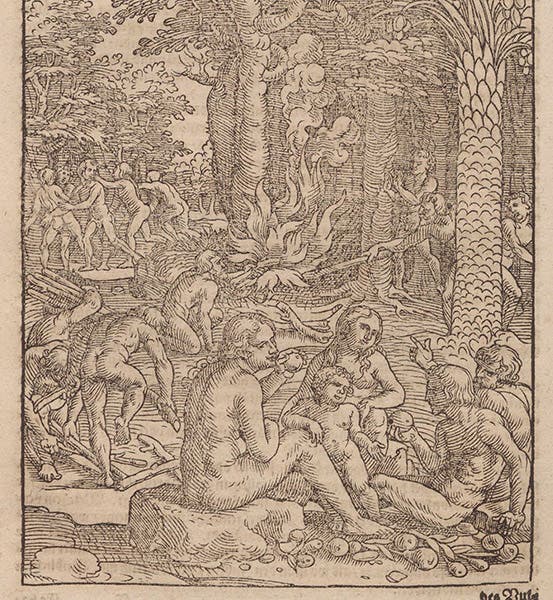
Discovering fire, illustrating a story in Vitruvius, woodcut, Bawkunst, oder, Architectur, by Walther Hermann Ryff, 3rd ed., p. 130, 1582 (The Linda Hall)
One thing we can do today is show you some of the wonderfully diverse woodcuts in our Bawkunst. We begin with a woodcut of levers at work, demonstrating the law of the lever by Archimedes, who is mentioned in the caption above. This is a wonderfully strong woodcut, well laid-out and cut.

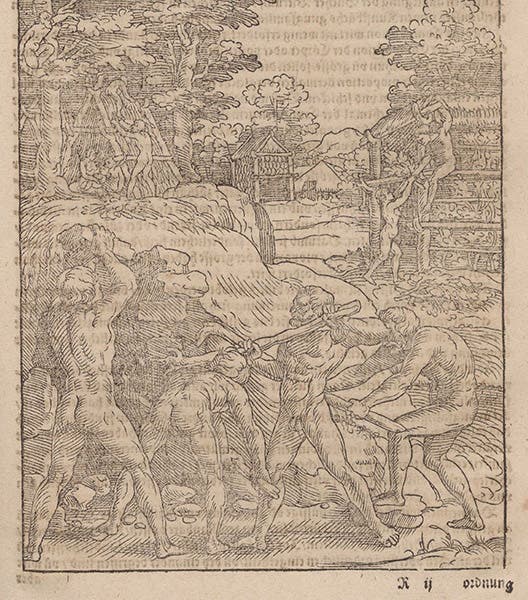
Inventing the art of building, illustrating a story in Vitruvius, woodcut, Bawkunst, oder, Architectur, by Walther Hermann Ryff, 3rd ed., p. 131, 1582 (The Linda Hall)
There are also two full page woodcuts on the discovery of fire and the invention of building (I show details because the entire woodcuts are too busy to see well). The stories they illustrate come right out of Vitruvius, and I seem to recall that the 1521 Como edition of De architectura had these very cuts, which Ryff then copied.

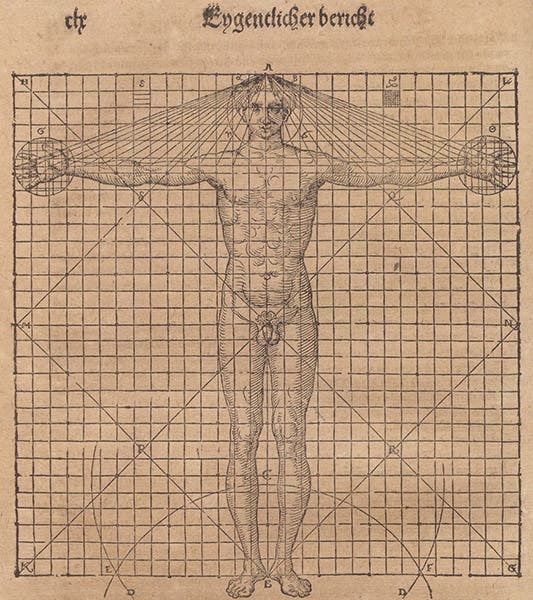
Vitruvian man 1, in a square, woodcut, Bawkunst, oder, Architectur, by Walther Hermann Ryff, 3rd ed., p. 160, 1582 (The Linda Hall)
We should perhaps mention that Ryff, in his own time, was best known as a plagiarist. He copied his images from wherever he could find them. This was fairly common in the 16th century, but Andreas Vesalius was considerably miffed when some of his muscle-men turned up in an anatomy book of Ryff. I do believe that the two Vitruvian men in Bawkunst, one in a square (fifth image), one in a circle (not shown) were also borrowed from the 1521 Vitruvius printed in Como.

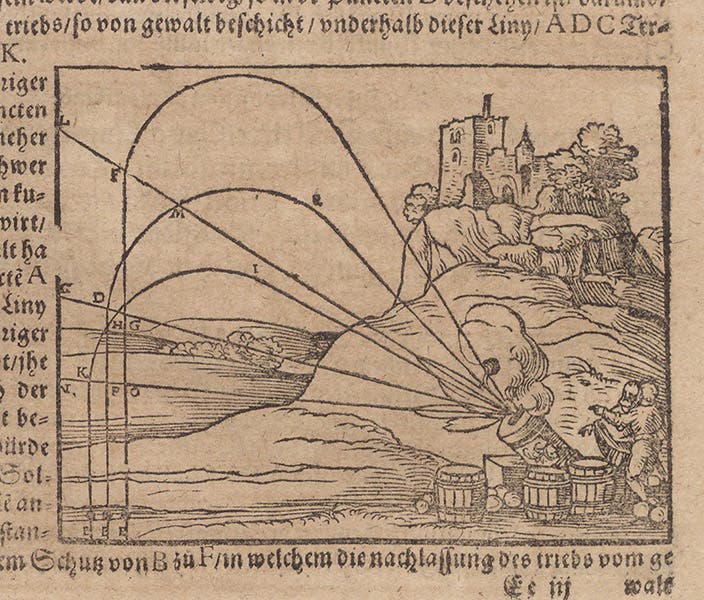
Ballistics of a cannon, illustrating the theory of impetus, woodcut, Bawkunst, oder, Architectur, by Walther Hermann Ryff, 3rd ed., p. 221, 1582 (The Linda Hall)
There are lots of images related to ballistics in Ryff, demonstrating the theory of impetus, and I am guessing that is because his printer, Officina Henripetrina, published a book on ballistics in 1551, which we have (but about which we have not yet written a post), and which contains images identical to the ballistics images in Ryff.

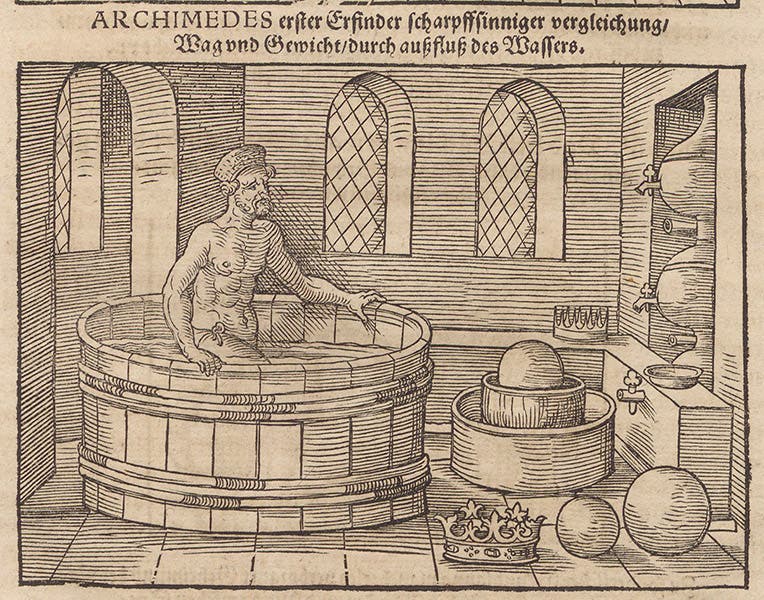
Archimedes assessing the purity of King Hiero’s crown, woodcut, Bawkunst, oder, Architectur, by Walther Hermann Ryff, 3rd ed., p. 392, 1582 (The Linda Hall)
The most often reproduced woodcut in Ryff has to be his portrait of Archimedes in the bath, shown having just discovered how to test Hiero's crown for purity by immersing it in water (seventh image). You can see the crown awaiting its test. Most image sources that reproduce this cut fail to mention that it comes from Ryff. Where Ryff got it from, I have no idea, but I would like to find out.

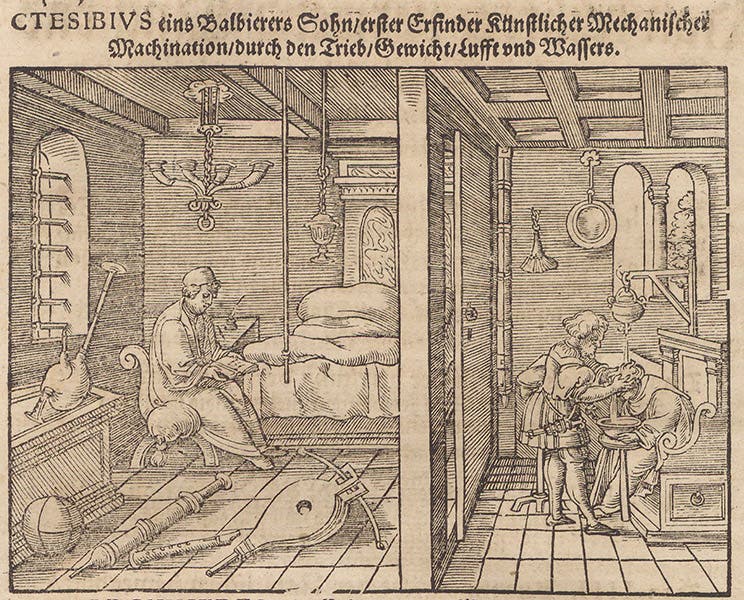
Ctesibius discovering the pinciples of pneumatics, woodcut, Bawkunst, oder, Architectur, by Walther Hermann Ryff, 3rd ed., p. 392, 1582 (The Linda Hall)
Just above the woodcut of Archimedes, on the same page, is a woodcut of Ctesibius, the father of pneumatics, who lived in the third century BCE (eighth image). Most people have never heard of him, but he had quite an influence on people like Hero of Alexandria. We shall have to write a post some day, and illustrate it with this woodcut.

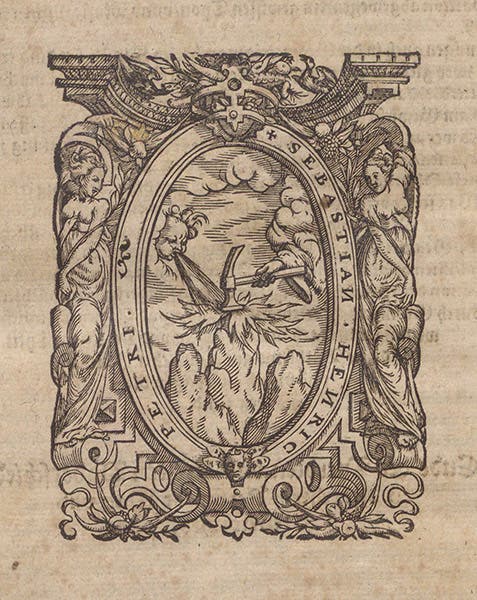
Printer’s mark for Sebastian Henricpetri, woodcut, Bawkunst, oder, Architectur, by Walther Hermann Ryff, 3rd ed., last page, 1582 (The Linda Hall)
Finally, we show you the last woodcut in the book, the printer's mark of Officina Henricipetrina, who printed our edition of Ryff's book (and the first two editions as well (ninth image). If it looks at all familiar to you, you might have seen it on the title page of the second edition of De revolutionibus, printed by the Henripetris in Basel, 1566 (last image).

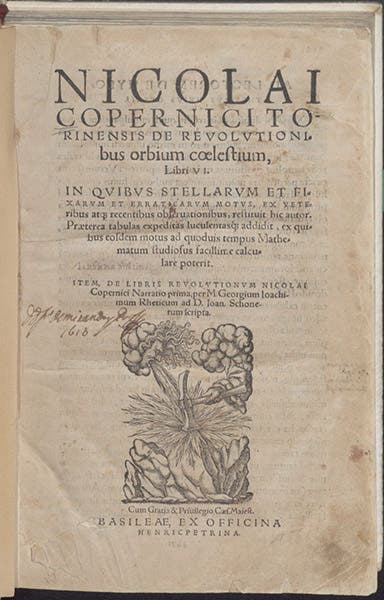
Title page of De Revolutionibus, by Nicolaus Copenicus, with printer’s mark of Officina Henricpetrina, woodcut, 1566 (The Linda Hall)
William B. Ashworth, Jr., Consultant for the History of Science, Linda Hall Library and Associate Professor emeritus, Department of History, University of Missouri-Kansas City. Comments or corrections are welcome; please direct to ashworthw@umkc.edu.

![“And I do mean YOU,” drawing of an Anopheles mosquito, by Theodor Seuss Geisel, This is Ann, [by Theodor Seuss Geisel and Munro Leaf], p. 32, 1943 (The Linda Hall)](https://assets-us-01.kc-usercontent.com:443/9dd25524-761a-000d-d79f-86a5086d4774/5aeabdb9-b9f5-40d6-8cf7-f7fff782da1d/seuss1.jpg?w=210&h=210&auto=format&fit=crop)