Scientist of the Day - Émile Cartailhac

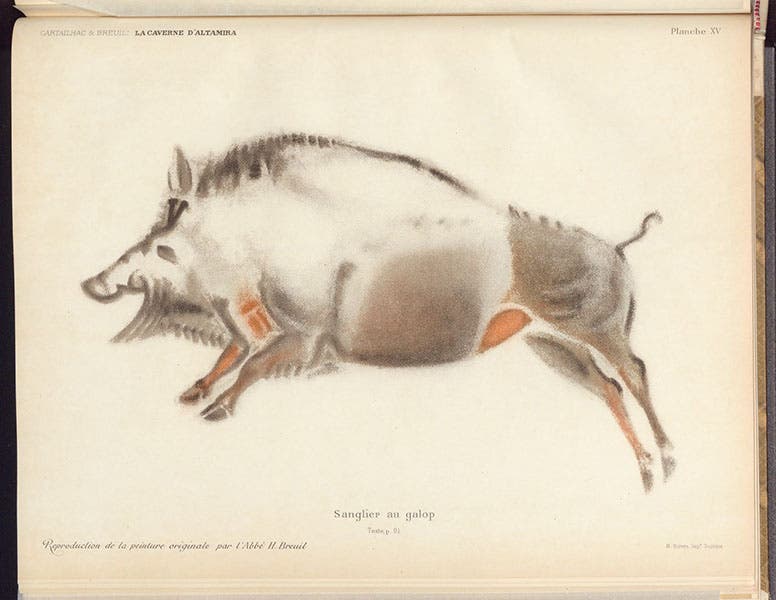
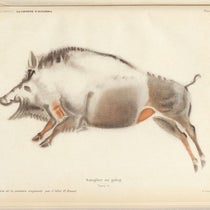
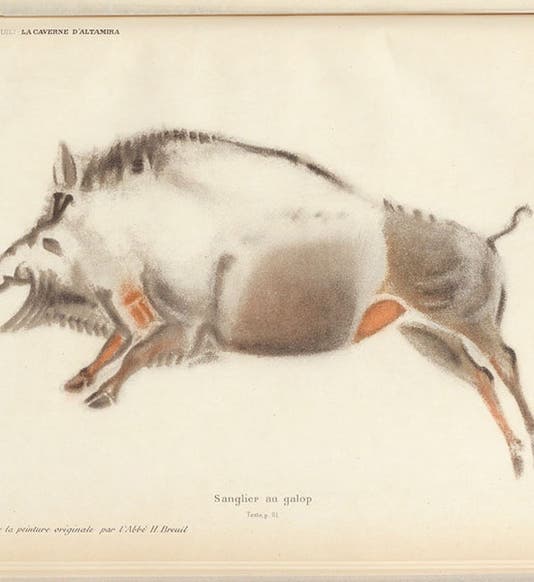
Sanglier au galop, “Wild boar running”, photoprint of a drawing by Henri Breuil, La caverne d'Altamira a Santillane, by Émile Cartailhac and abbé Henri Breuil, plate XV, 1906 (The Linda Hall)
Émile Cartailhac, a French archaeologist, died Nov. 25, 1921, in Geneva, at the age of 76. In 1880, Cartailhac, along with the other leading archaeologists of France, attended a meeting in Lisbon at which evidence was presented by Don Marcelino Sanz de Sautuola that prehistoric humans had painted pictures of animals on the ceiling of a cave at Altamira in Spain. Cartailhac and his peers emphatically rejected the possibility of prehistoric art, and they refused an invitation to visit the cave and see for themselves.

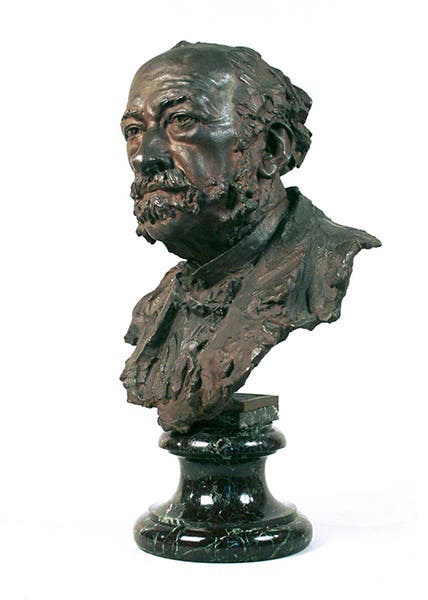
Portrait bust of Émile Cartailhac, patinated bronze, by Victor Segoffin, cast 1922, Museum Toulouse (collections.sciences-humaines-sociales.museum.toulouse-metropole.fr)
Twenty-two years later, Cartailhac, having been confronted with cave paintings in France, did a dramatic about-face. In a paper that he called the "Mea culpa of a skeptic," published in L'Anthropologie in 1902, he admitted that he was wrong in his denial of cave art, and he apologized to the daughter of Sanz de Sautuola (who had since died in disgrace) for implying that the cave paintings had been forged. Historians debate whether this mea culpa was a sincere confession, or a ploy to make the best of a now untenable position.

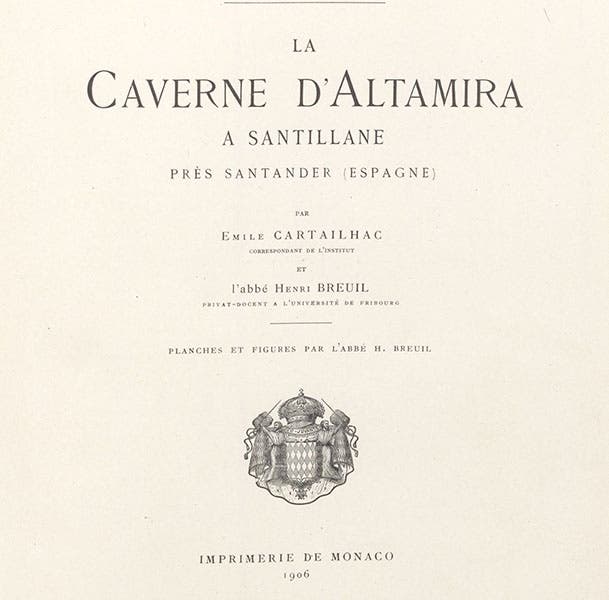
Title page, detail, La caverne d'Altamira a Santillane, by Émile Cartailhac and abbé Henri Breuil, 1906 (The Linda Hall)

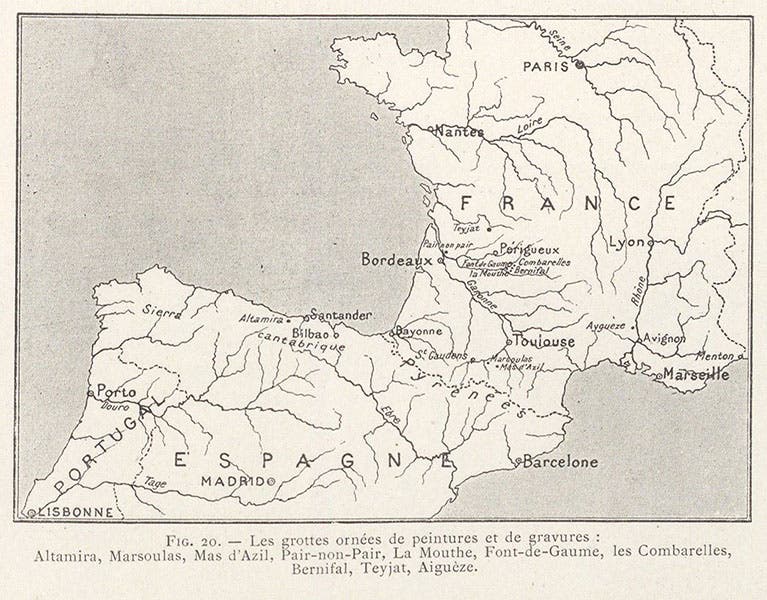
Map of Spain and Fance, showing the location of Altamira in northern Spain, and other sites containing Paleolithic art, in La caverne d'Altamira a Santillane, by Émile Cartailhac and abbé Henri Breuil, p. 36, 1906 (The Linda Hall)
Whichever the case, Cartailhac (along with abbé Breuil) revisited Altamira and published a beautiful book, La caverne d'Altamira, in 1906, with colored illustrations of the cave paintings by Breuil, making them available for the first time for the public to appreciate. We did not have this book in the Library when we organized our exhibition, Blade and Bone: The Discovery of Human Antiquity (2012), so we had to use copies of the Altamira paintings as published in later books and magazines, which actually were quite attractive and pleasing, as you can see in this section of the exhibition. But they were not the original Breuil drawings, and when we finally acquired the 1906 book this past spring, we were quite excited, and remain so. It is a lovely, lovely book.
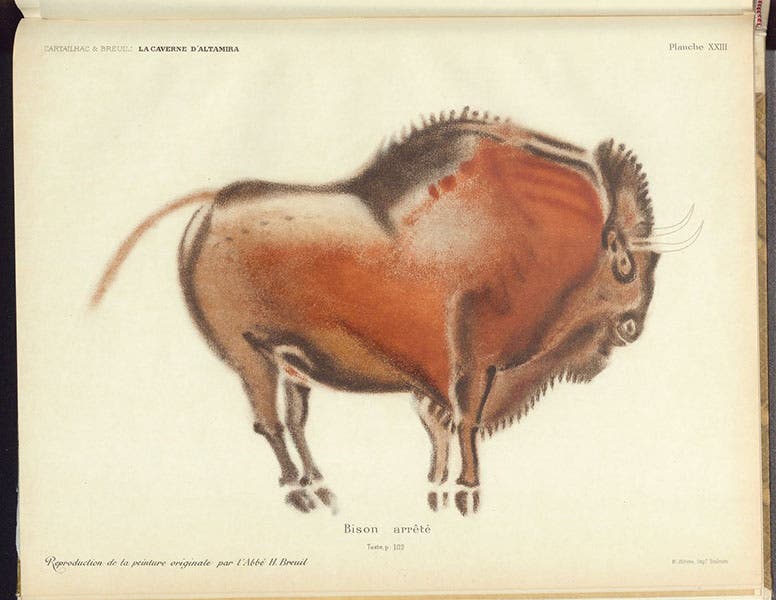
Standing bison, photoprint of a drawing by Henri Breuil, La caverne d'Altamira a Santillane, by Émile Cartailhac and abbé Henri Breuil, plate XXIII, 1906 (The Linda Hall)

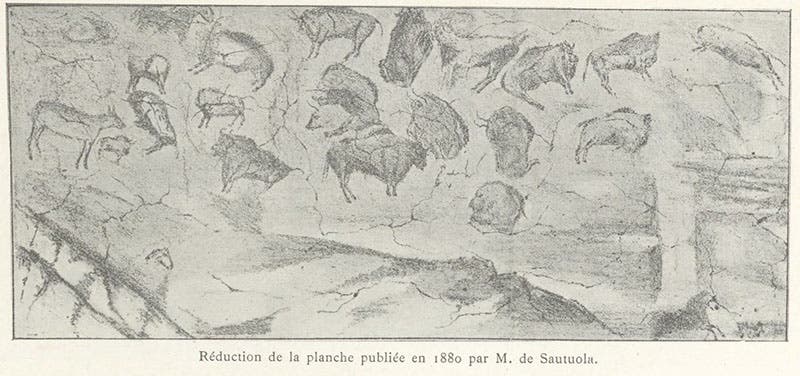
Drawing of the Altamira cave ceiling by Don Marcelino Sanz de Sautuola, originally published in 1880, reduced copy in La caverne d'Altamira a Santillane, by Émile Cartailhac and abbé Henri Breuil, top half of plate I, 1906 (The Linda Hall)

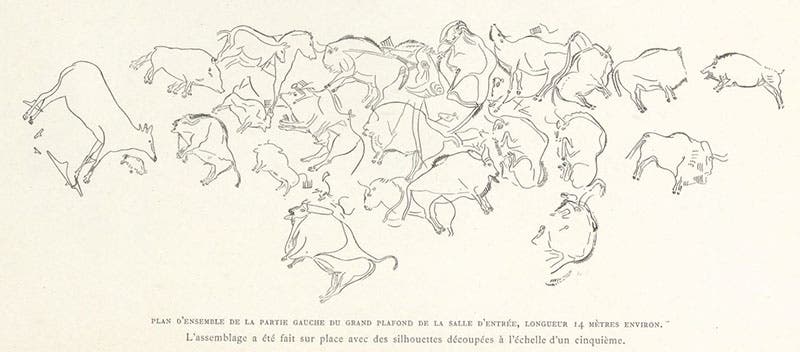
Sketch of the Altamira cave ceiling as I appeared in 1905, La caverne d'Altamira a Santillane, by Émile Cartailhac and abbé Henri Breuil, bottom half of plate I, 1906 (The Linda Hall)
We first announced the acquisition in a post on Breuil this last August, when I displayed four of Breuil’s paintings, and promised to show more when the next Cartailhac anniversary rolled around, which happens today. I also said I would show some of the maps and drawings that appeared in Cartailhac’s half of the book (the text), and I have made good on that promise as well (see the three images above).
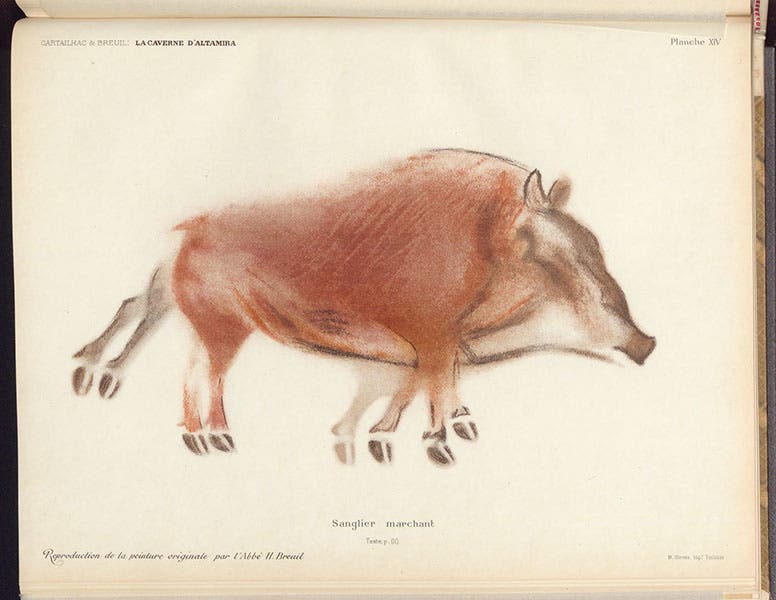
Sanglier marchant, “Wild boar walking,” photoprint of a drawing by Henri Breuil, La caverne d'Altamira a Santillane, by Émile Cartailhac and abbé Henri Breuil, plate XIV, 1906 (The Linda Hall)
Finally, I include one drawing a second time, the walking boar (last image). When I showed it the first time in the post on Breuil, I commented in the caption that it must show two boars in line, because there are 8 legs. I intended that as a joke, but several of you wrote in to point out that it might be a way of showing an animal in motion. It might indeed, although one might wonder why the sanglier au galop (first image) doesn’t have any extra legs helping him galop. Presumably the experts in Paleolithic art know what is going on with the 8 legs, but they haven’t been very forthcoming with the public.
There is a dramatic bust of Cartailhac in the Museum Toulouse; we have used it for our portrait (second image)
William B. Ashworth, Jr., Consultant for the History of Science, Linda Hall Library and Associate Professor emeritus, Department of History, University of Missouri-Kansas City. Comments or corrections are welcome; please direct to ashworthw@umkc.edu.